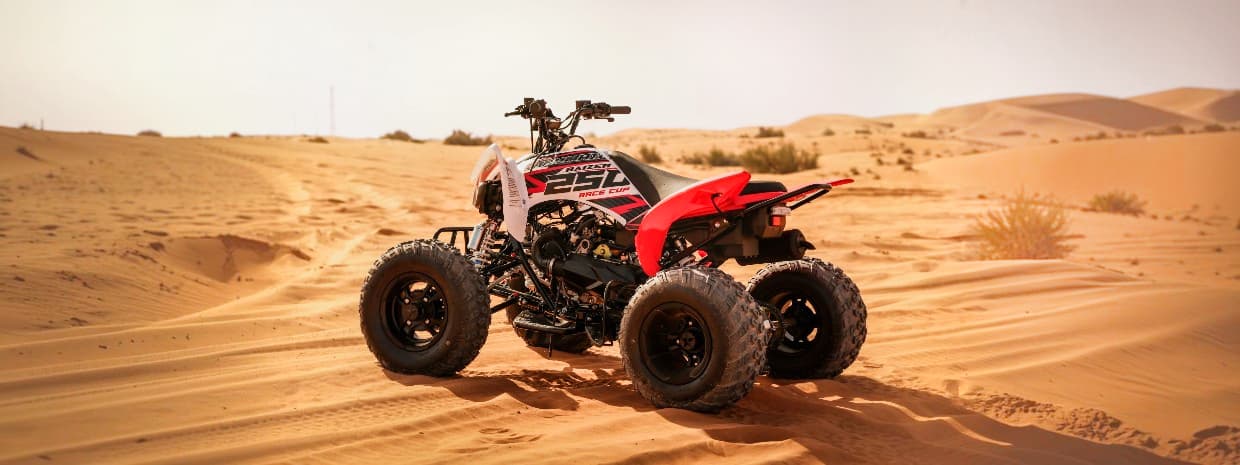
Choosing the right tires for your ATV in the UAE: a comprehensive guide
Find the right ATV tires for your terrain in the UAE. Our comprehensive guide covers tire types, sizes, tread patterns, and top picks for every surface.
20 Jul 2026
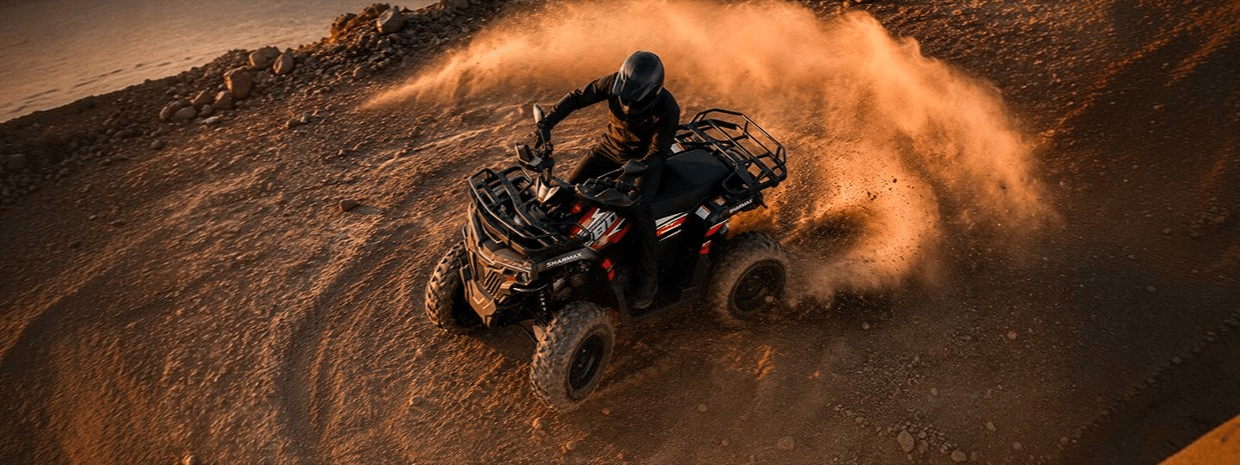
Choosing the right tires for your ATV in Qatar: a comprehensive guide
A rider can easily get lost when choosing wheels for an ATV for the first time as this is a very specific purchase. You don't have to get deeply involved in the mechanical side of it, though. You just need to understand the tread pattern and know what tire size your ATV needs. All this and a little bit more, and now you are confident enough to compare and choose. Below, we have prepared a comprehensive ATV tires buying guide to help you understand how to choose ATV tires easily and avoid unnecessary guesswork.
How to read ATV tire size markings
Those strange numbers like 25×8-12 or 26×10-14 actually mean the size. Let's decode this formula step by step with our simple ATV tire size guide:
- 25 or 26 — the outer tire diameter in inches. It affects ground clearance and the overall ride height of the ATV.
- 8 or 10 — the tread width in inches. A wider tire can give better grip on loose ground, but it may feel less precise on hard surfaces.
- 12 or 14 — the rim diameter in inches. This value must be the same as your rim diameter.
Do not install tires larger than the size recommended by the manufacturer. Bigger sizes can overload drivetrain parts and make the ATV harder to steer.
⚠️Note: If the marking says 25×8.00-12, and the rim says 12×7, it means the rim is 12 inches in diameter and 7 inches wide, which can suit an 8-inch-wide tire. A difference of about ±1 inch is usually acceptable, but going too far beyond that can cause uneven wear.
Radial or bias: which construction to choose?
The final letter in the marking (eg. 25×8-12 R) also has a meaning. It shows the type of construction where B means bias-ply and R means radial.
Bias tires are the old-school tough guys. They are usually stiffer, stronger against side impacts, and more affordable. They suit smaller ATVs, utility use, and rough terrain where durability matters more than comfort.
Radial tires are more flexible. They absorb bumps better, roll more smoothly, and can help reduce rolling resistance. They are usually better for more powerful ATVs, longer rides, and riders who want more comfort and stability.
For small ATVs up to about 250cc, the bias configuration is more common. For 500cc+ machines, radial tires can be a better upgrade, especially if you ride faster, longer, or on mixed terrain.
How to choose ATV tires by terrain: tread pattern basics
Universal ATV tires do not really exist. Even models marked as all-terrain are usually weaker than those made for specific conditions. There are not that many major tread patterns for ATVs. In fact, most options can be divided into three basic types. Let's look at the best choices for different surfaces and see where each type makes sense.
ATV tires for mud
- Size: 28×9-14 or 30×10-14
- Tread pattern: "herringbone" or zigzag-style pattern
- Pressure: 0.3–0.5 bar, but not lower — otherwise the tire may come off the rim

ATV tires for mud have a very specific tread pattern that spreads from the center toward the sidewall at an angle. Mud models can also handle other off-road surfaces, except hard paved roads. If you are not a professional racer, it is better to choose the tread with medium-aggressive lugs.
Mud tires usually have tall lugs of around 2.5–3 cm on the tread surface. These lugs are separated by wide open spaces. The idea behind this design is self-cleaning. As the tire moves through mud, dirt is pushed from the center of the tread toward the sides and then out of the track. The faster the wheel rotates, the faster this self-cleaning effect works.
Despite an aggressive look, they are not always choice out there:
- They wear faster outside the mud.
If you ride them often on asphalt, concrete, or other hard surfaces, the tread will wear down much faster. - They are not very comfortable.
The tread pattern is aggressive, so they will not feel as smooth as standard factory wheels. - They have weaker side stability on hills.
Mud tires usually have a directional center-focused tread pattern. This means side grip on hilly terrain can be average, especially when riding across a slope.
ATV tires for sand
- Width: 10–12 inches, for example 26×12-12
- Tread pattern: tall paddle-style lugs
- Pressure: 0.2–0.4 bar for a larger contact patch

ATV tires for sand have a very specific tread pattern, often called paddle or scoop-style. The rear tires use large "blades" across the tread, which help push the ATV forward instead of letting it dig into the sand.
The front tire is usually different. It often has a central rib running along the tread. This rib helps the ATV keep a straight line in soft sand. Without it, steering becomes vague, and the front wheels may start floating around like they forgot their job.
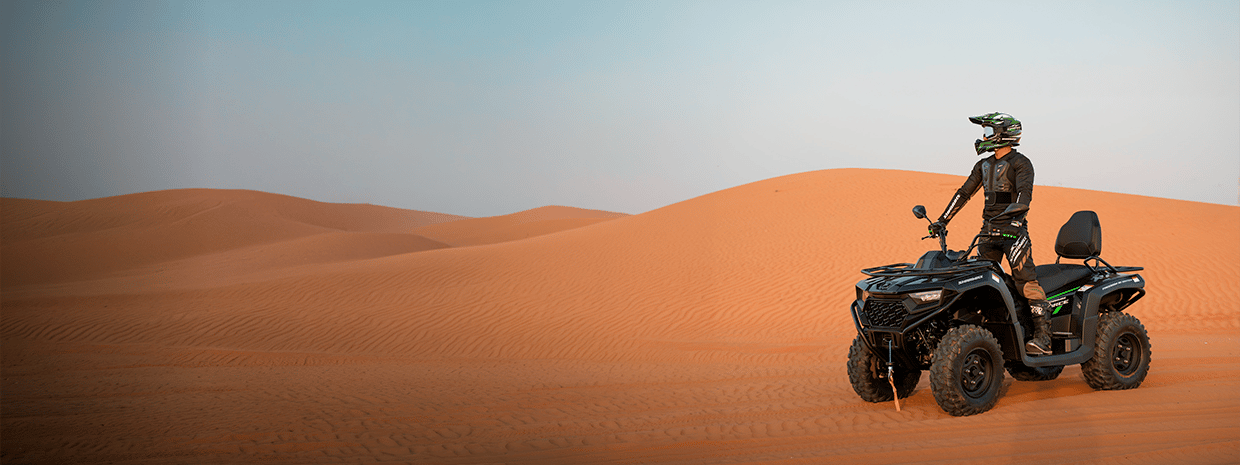
Sand tires are strongly recommended for dunes. Regular options can dig in quickly, make the engine work harder, and lead to overheating, especially if the ATV is forced to fight through deep loose sand for a long time.
However, this configuration has several clear drawbacks:
- They are only made for sand and dunes.
They are too specific for general off-road riding and should not be used on dirt roads, mud, rocks, or asphalt. - They have weak side stability outside sand.
Their paddle-style tread is made to push forward, not to give strong side grip on harder or uneven surfaces. - They wear out very quickly on hard ground.
A short ride on pavement, gravel, or packed dirt can damage them faster than expected.
So, buying this type only makes sense if you ride dunes regularly. If you go to sandy areas once in a while, all-terrain ATV tires may be enough.
All-terrain ATV tires
- Width: 8–10 inches, for example 25×8-12 or 26×10-12
- Tread pattern: medium-depth mixed tread with balanced lugs
- Pressure: 0.4–0.8 bar, depending on terrain and load

All-terrain ATV tires represent a compromise for riders who move across different surfaces. They will not outperform specialized tires, but they can give stable and predictable performance on most everyday off-road routes.
The tread pattern can vary a lot but the general tread depth is usually around 1.25–2 cm. If your routes change often, look for all-terrain tires with good self-cleaning ability.
For mixed routes such as forest plus dirt road, look for tires marked Trail or Hybrid, like in Kenda Executioner or GBC Dirt Tamer.
Popular ATV tire brands to consider in 2026
Below is a short ATV tires comparison of popular options riders often consider for mixed off-road use.
Maxxis Carnivore (27×9-12)
This one gets recommended a lot, and mostly for good reason. The tread is aggressive enough for rocks and roots, the 8-ply radial construction handles rough ground without the sidewall folding under pressure, and it transitions reasonably well between different surfaces. If you ride mixed terrain and want one set of wheels that does not demand constant swapping, this is a practical starting point.
The catch: it is heavier than basic trail tires and does not behave like a dedicated sand tire on open dunes.
ITP Mud Lite (28×10-12)
Built specifically for wet, sticky terrain — mud, swamp ground, soft soil after rain. For most Middle East riders, that is a niche situation. It could work around farms, in wadis after heavy rain, or on specific soft sections. But on hard-packed gravel or open desert, the noise gets irritating fast and the tread works against you. Useful to know about. Not the first choice for most riders here.
Kenda Bearclaw HTR (25×8-12)
A quieter, more balanced option that suits riders who spend most of their time on gravel, compact dirt, and farm tracks rather than deep mud or dunes. It will not win in extreme conditions but it also will not punish you on the way home when the terrain flattens out. A solid choice if your riding is genuinely mixed and not dominated by one surface type.
CST Abuzz / Stag (25×8-12 / 26×9-12)
These show up regularly as everyday trail tires, and that is probably the right way to think about them. Hard-packed tracks, general recreational riding, gravel routes — they handle all of that without drama. Do not expect them to dig out of deep mud or float across soft dunes. Within their range though, they are predictable and easy to live with.
GBC Dirt Commander (30×10-14)
The biggest and most aggressive option on this list. They are great for rocky trails and uneven broken ground. The trade-off is weight and rolling resistance. On smoother surfaces it feels sluggish, and fuel consumption goes up noticeably. Worth it if your riding regularly involves genuinely rough terrain. Harder to justify if it does not.
One thing most buyers overlook: check the DOT marking before you buy any tire. The last four digits show the week and year it was made. A tire sitting in a warehouse for three years has already aged — rubber loses elasticity over time regardless of whether the tire has ever touched the ground.
Common mistakes when choosing ATV tires
Even experienced riders sometimes make critical mistakes that lead to expensive repairs. Here are the top 5 mistakes we have seen in service centers:
Ignoring the load index
ATV tires usually have a ply rating from 4PR to 8PR: the higher the rating, the stronger the material. For example, a Kenda Bearclaw 6PR can carry up to 340 kg per wheel, while an ITP Mud Lite 4PR carries around 225 kg. If the tire is overloaded, the sidewall can start to bulge, creating so-called "hernias."
Mounting directional tires the wrong way
Many ATV tires have a rotation arrow on the sidewall. If the tire is installed against the correct direction, self-cleaning and grip can drop by 20–30%, especially in mud and loose terrain.
Saving money on wheel balancing
A wheel imbalance of more than 20 grams at speeds above 70 km/h can cause strong vibration. Over time, this vibration can destroy hub bearings within 1–2 riding seasons.
Using car or truck tires
Automotive tires are not designed for ATV suspension geometry, low pressure, or off-road sidewall flex. A stiff sidewall can reduce grip, overload suspension parts, and increase the risk of cord damage.
Ignoring tire pressure
For mud, the pressure is often lowered to around 0.3–0.5 bar. But many riders forget to bring it back to normal levels, around 0.8–1.2 bar, before riding on asphalt or hard-packed roads. This can lead to overheating and tread separation.