How to check motorcycle engine condition before buying in Saudi Arabia
Learn how to check a motorcycle engine before buying in Saudi Arabia. Get practical tips for evaluating engine condition with confidence.
28 Aug 2026

If you're not going to buy a new motorcycle for sale and decide to go for something pre-owned instead, the engine is the one part you can't afford to take on faith.
Learning how to check motorcycle engine condition properly before you hand over any money is the single best insurance policy against buying someone else's expensive problem.
This guide walks through a practical motorcycle engine inspection checklist you can realistically run through in a parking lot, using nothing more exotic than your eyes, ears, and a compression gauge.
Start the motorcycle engine inspection before starting the bike
One of the most useful things you can do is inspect the motorcycle while the engine is still cold. A warm engine can sometimes start more easily and hide problems that become obvious after the bike has been sitting for several hours.
What to inspect while the engine is cold
Look around:
The engine cases
The cylinder head
Gaskets and seals
Oil lines and coolant hoses
The radiator
The area beneath the motorcycle
The exhaust headers
The chain and front sprocket area
Fresh oil traces may indicate an active leak, while dried residue can show that the problem has existed for some time. Check for coolant stains as well, especially around hose connections, the radiator, and the water pump.
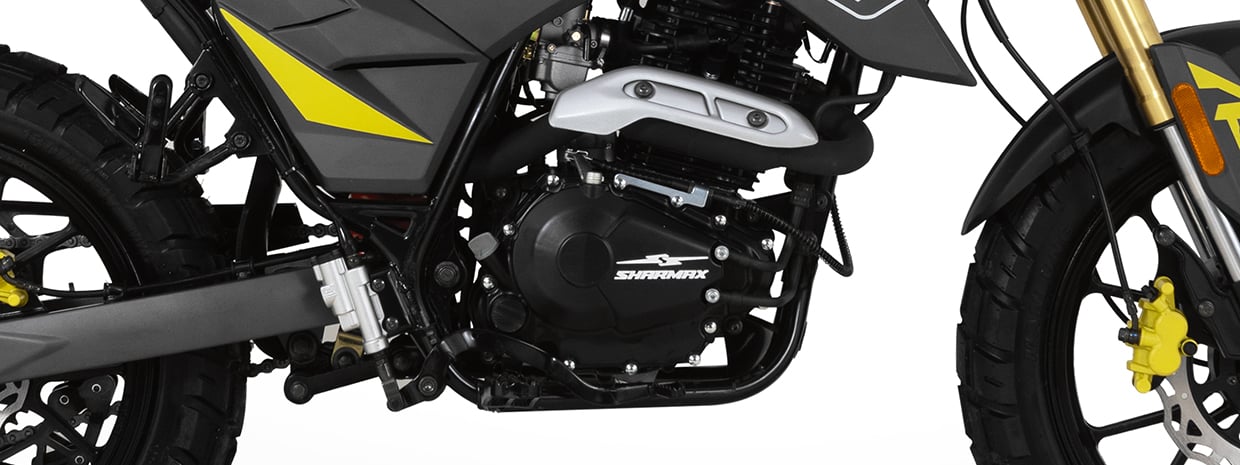
How to inspect a motorcycle engine during a cold start
If you're serious about learning how to test motorcycle engine condition accurately, insist on seeing the bike started from completely cold. Sellers sometimes warm the engine before you arrive, since a warm engine hides rough starts, knocking, and rattly cold-start noise that only show up in the first few seconds after ignition.
Ask the seller not to start the bike before you get there.
Touch the engine cases and exhaust — they should be cool.
Listen closely to the first 10–15 seconds after ignition for knocking, rattling, or heavy smoke.
Cold-start warning signs
Be cautious if the motorcycle:
Requires repeated attempts to start
Needs excessive throttle input
Produces loud mechanical noise immediately after starting
Stalls repeatedly
Idles unevenly
Emits heavy smoke
Takes an unusually long time to settle into a normal idle
A bike that struggles to fire up cold, needs several attempts, or immediately has to be revved high just to stay running is already telling you something worth digging into further.
Listen for suspicious sounds
Sound is the fastest, cheapest way to catch a problem, and it's the backbone of any real motorcycle engine health check. The trick is isolating where a noise is actually coming from — an odd sound at speed could be the engine, or it could just as easily be the chain, a wheel bearing, or a loose panel.
| What You Hear | Likely Source |
|---|---|
| Rhythmic tapping or clicking at idle | Valve clearance out of adjustment |
| Deep knocking that gets worse under load | Worn bearings or piston slap — serious concern |
| High-pitched whine that changes with speed | Chain, belt, or final-drive wear |
| Metallic rattle that varies with throttle | Loose heat shield or exhaust bracket, not necessarily the engine |
To narrow it down: let the bike idle in neutral first, then rev it gently with the rear wheel off the ground. If a noise only appears in one specific gear, it's pointing at the transmission rather than the engine itself.
Check the gauges and warning lights
Not every bike has an oil pressure or temperature gauge, but where one exists, it's one of the most reliable early-warning tools available during a motorcycle engine assessment. A temperature spike during a test ride, especially at idle or low speed, is worth taking seriously — in the Gulf climate it can mean anything from a genuinely hot day to a clogged radiator, low coolant, or a failing fan, and you won't know which without investigating.
Watch the temperature needle during idle — it shouldn't climb steadily with no ceiling
An illuminated oil pressure light at idle is an immediate red flag, not something to "monitor"
On air-cooled bikes, check the cooling fins for dust and debris buildup, which restricts airflow
Inspect the spark plugs where practical
Pulling a spark plug takes five minutes and tells you more about combustion health than almost any other single check. This step alone is worth building into your own motorcycle engine evaluation guide for every used bike you look at.
| Plug Condition | What It Suggests |
|---|---|
| Oily, black, wet deposits | Oil entering the combustion chamber — check rings and compression |
| Dry, reddish-brown deposits | Lean fuel mixture, needs carburetor or injector attention |
| Clean, light tan color | Healthy combustion — a good sign |
| Cracked insulator or arcing marks | Faulty plug, unrelated to engine wear |
Check oil condition and ask about consumption
Oil that's dark, gritty, or smells burnt is one thing — but the more telling detail is how much oil the engine has been using between changes. A sudden increase in oil consumption almost always signals worn rings, scored cylinder walls, or a seal that's no longer holding. Ask directly:
When was the oil last changed, and with what grade?
Has the seller noticed the bike using more oil recently?
Is there any visible oil residue around the base of the engine or exhaust header?
Vague or evasive answers here are a bigger warning sign than the answers themselves.
How to test motorcycle engine condition with a compression test
This is the closest thing to an objective, numbers-based way to inspect a motorcycle engine, and it's worth doing on any bike you're seriously considering.
Basic compression test:
a simple gauge screwed into the spark plug hole while the starter turns the engine over. Compare the reading against the manufacturer's spec — low compression across all cylinders points to worn rings or cylinder wear; uneven compression between cylinders on a multi-cylinder engine is often worse news than low-but-equal readings.
Leak-down test:
a more thorough method using an external air compressor and a gauge to measure how well the cylinder holds pressure. Listening at the exhaust, intake, and crankcase breather while the test runs can pinpoint exactly which valve or seal is letting air past.
Both tests should be run on a warmed-up engine for accurate results — a cold engine will almost always read lower than it actually is.
Check the exhaust smoke color
The exhaust can provide useful clues about motorcycle engine condition. Smoke color during startup and acceleration is a quick visual gut-check that costs nothing and takes seconds.
Blue or bluish smoke: Oil may be entering the combustion chamber. Possible causes include worn piston rings, cylinder wear, or valve-seal problems.
Dark or black smoke: The engine may be running too rich, or there may be a fuel-injection, air-filter, or sensor issue.
White smoke after warm-up: This may indicate coolant entering the combustion chamber on a liquid-cooled engine, although some engines naturally produce light vapor in certain conditions.
Heavy smoke under acceleration: This can suggest internal wear that becomes more noticeable when the engine is under load.
Take it for a real test ride
Everything checked so far happens with the bike stationary or idling. A test ride is where engine problems that only appear under load reveal themselves. This step belongs at the center of any serious motorcycle engine inspection.
Accelerate hard through a couple of gears and listen for hesitation, misfires, or power loss
Let the bike idle at a stop for a minute and make sure the idle stays steady, not surging or dying
Roll off the throttle at speed and listen for any knocking on deceleration
Check that the bike returns to a normal, stable idle after a hard run, not an elevated or rough one
During the test ride, check for:
Smooth starting from a stop
Consistent acceleration
Strong, even power at higher rpm
Excessive vibration
Misfiring under load
Overheating in traffic
Warning lights
Unusual engine or transmission noises
After stopping, inspect the engine once more. Heat and pressure may reveal oil or coolant leaks that were not visible when the motorcycle was cold.
Cross-check the service history
Records don't replace a hands-on inspection, but they add useful context. A bike with consistent, documented servicing that still shows one of the warning signs above deserves a harder look — it means the issue developed despite proper care, which is a different risk profile than a neglected machine.
Before buying, ask the seller:
Is there a complete service history?
When was the last oil and filter change?
Has the motorcycle ever overheated?
Has the engine been rebuilt or modified?
Are there any warning lights or known faults?
Can I arrange an independent inspection?
Oil type matters too. Check whether the owner has been using oil that meets the manufacturer's specification rather than judging the engine only by the color of the oil currently inside it.
The full motorcycle engine inspection checklist
| Step | What to Check | Red Flag |
|---|---|---|
| Cold start | Starts smoothly within a few seconds | Multiple attempts, high idle needed to stay running |
| Sound | Even, consistent note at idle and under load | Knocking, tapping, whining that changes with RPM |
| Gauges | Oil pressure light off, temperature stable | Warning light stays lit, temperature climbs unchecked |
| Spark plugs | Light tan, dry deposits | Oily black, wet, or cracked insulator |
| Oil | Clean-ish, no burning smell, consistent usage | Sudden increase in consumption, gritty texture |
| Compression | Matches factory spec, even across cylinders | Low overall or uneven between cylinders |
| Exhaust smoke | Clear or very light haze on startup | Blue, white, or heavy black smoke |
| Test ride | Smooth acceleration, stable idle after hard riding | Hesitation, misfires, rough return to idle |
| Service history | Consistent, documented intervals | Gaps, inconsistent mileage records |
Why a new bike from an official dealer still wins
Everything above exists because used bikes carry unknowns, and no inspection, however thorough, ever removes all of them.
With a dealer like Sharmax, every motorcycle comes with a 3-year warranty, backed by an authorized service center that knows your motorcycle from day one.
You can also book a test ride before you commit, so you're judging the bike on how it actually feels and runs, not just on paper.
Choosing a new motorcycle from an official dealer gives you a much clearer starting point, with documented vehicle condition, professional support, and warranty coverage from day one.