Diesel vs petrol vs electric UTVs: which engine makes sense in Saudi Arabia
Compare diesel, petrol, and electric UTVs in Saudi Arabia. Discover their costs, performance, efficiency, and maintenance needs to choose the right option for you.
23 Oct 2026
Diesel UTVs are still not so common on the market, but they are gaining attention among professional users and riders who need better fuel efficiency under load. Petrol models remain the most familiar choice, especially for recreational and performance use. Electric UTVs are also becoming more visible as battery technology improves and more manufacturers enter the segment.
If you are comparing UTVs for sale in Saudi Arabia, the choice between diesel, petrol and electric depends a lot on how you are going to use your vehicle. The engine type also defines maintenance and the overall ownership experience. In this guide, we compare all three powertrain types and look at which one makes the most sense for Saudi Arabia conditions.
Petrol UTV pros and cons
Petrol UTVs are the most common choice in the recreational and performance side-by-side market.
Pros:
Quick throttle response
petrol engines usually feel more responsive and lively, which suits recreational and sport riding.
Strong acceleration
they generally offer good performance across a wide rev range.
Lower engine weight
petrol setups are often lighter than comparable diesel engines.
Easy refuelling
filling the tank takes only a few minutes, which is convenient on longer trips or remote routes.
Wide model choice
petrol remains the most common powertrain in the UTV market, so buyers usually have more options across different sizes and performance levels.
Cons:
More engine noise
petrol UTVs are noticeably louder than electric models.
Higher fuel consumption
petrol UTV fuel economy can vary significantly depending on engine size, vehicle weight, terrain and driving style. Large sport models used aggressively in sand will usually consume more fuel than smaller utility models driven at steady speeds.
Regular servicing
oil, filters, spark plugs and other conventional engine components need routine maintenance.
Fuel costs add up
for vehicles used frequently or over long distances, fuel becomes a significant part of the running cost.
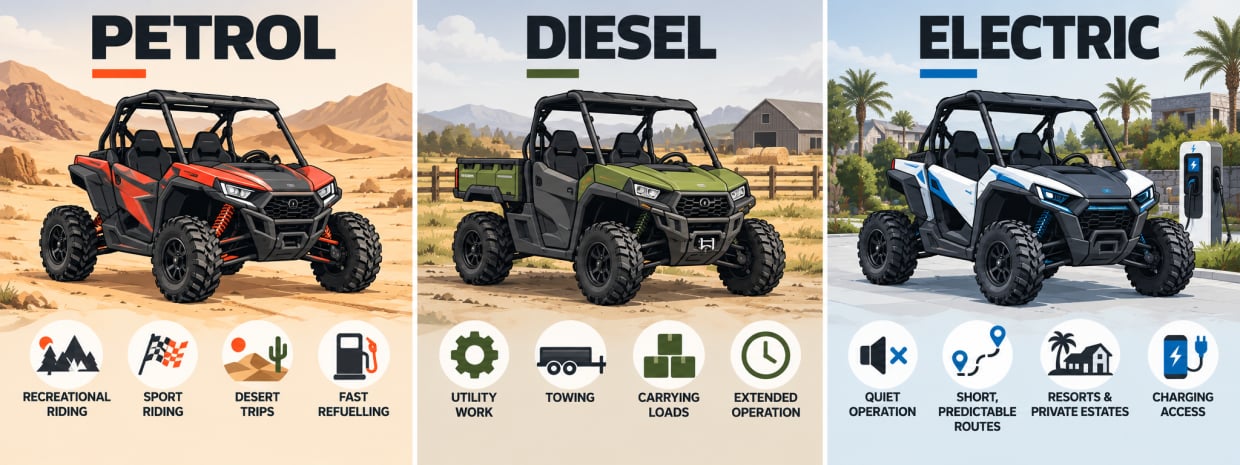
In Saudi Arabia, if you want a UTV mainly for desert riding, recreational trips or faster off-road use, a petrol model will usually suit you best
Diesel UTV advantages and disadvantages
Diesel UTVs are less common than petrol models, but they can be a strong choice for utility-focused use. Their main advantage is strong low-end torque, which suits towing, carrying loads and steady off-road work.
Pros:
Strong low-end torque
diesel engines deliver good pulling power at lower rpm, which helps with towing, hauling and climbing under load.
Good fuel efficiency
diesel UTV fuel efficiency can be better during long periods of steady operation, especially when the vehicle is working under a consistent load.
Well suited to utility work
diesel models make sense for farms, industrial sites, large properties and other applications where the UTV may run for hours at a time.
Good for slower off-road use
the torque-focused power delivery works well on rough terrain where control and pulling force matter more than outright speed.
Cons:
Heavier powertrain
diesel engines are often heavier than comparable petrol setups, which can make the UTV feel less agile.
Slower throttle response
they generally do not feel as quick or lively as petrol UTVs when accelerating.
Less suited to sport-focused riding
diesel is usually a weaker fit for riders who want fast acceleration and high-speed desert driving.
Potentially higher repair costs
depending on the engine and fuel system, diesel components can be more complex and expensive to repair.
If you need a UTV mainly for towing, carrying equipment, farm or site work, or slower long-duration off-road use, a diesel model can be a very practical choice.
Electric UTV benefits and drawbacks
Electric UTVs are becoming more relevant for both work and recreational use, especially where low noise and simple day-to-day operation matter. Their strongest advantages come from the electric drivetrain itself.
Pros:
Instant torque
electric motors deliver pulling power immediately, which is useful for low-speed off-road driving, climbing and carrying loads.
Very quiet operation
electric UTVs suit resorts, private estates, farms, parks, warehouses and other areas where noise needs to be kept low.
Lower routine maintenance
there is no engine oil, spark plug or exhaust system to maintain in the same way as on a petrol model.
Smooth power delivery
acceleration is usually very linear, with no gear changes or engine revs to manage in the same way as with an internal-combustion setup.
No tailpipe emissions
this can be useful for enclosed or controlled working environments.
Cons:
Limited range
how far an electric UTV can travel depends on battery capacity, terrain, payload, driving style and temperature.
Longer charging time
charging takes much longer than filling a petrol or diesel tank.
Charging access matters
electric models work best when the vehicle regularly returns to a base where it can be plugged in.
Battery cost
the battery is one of the most expensive components and may eventually need replacement.
Heavy battery packs
larger batteries can add significant weight to the vehicle.
For a UTV aimed mainly for resorts, private properties, farms, parks or other short-distance routes where the vehicle returns to the same base, an electric model can be a very practical choice. For long desert trips or remote recreational riding, petrol is still generally easier because refuelling is much faster.
UTV engine comparison: petrol, diesel and electric
So when asking diesel petrol or electric UTV which is better, there is no universal winner. The best option is the one that matches the operating environment.
Diesel UTV vs petrol UTV
| Petrol | Diesel | |
|---|---|---|
| Best suited to | Recreation, sport, desert riding and mixed use | Utility work, towing and heavier loads |
| Power delivery | Responsive, quicker acceleration | Strong low-end torque |
| Refuelling | Fast | Fast |
| Fuel efficiency | Usually higher fuel consumption | Often more efficient under steady load |
| Noise | Moderate to high | Usually higher |
| Weight | Generally lighter | Often heavier |
| Driving feel | More agile and lively | More torque-focused and steady |
| Market availability | Very broad | More specialised |
In terms of fuel consumption and efficiency: a diesel utility UTV may use around 6–9 L/100 km, while comparable petrol UTVs can often be closer to 9–12 L/100 km or more, especially with larger engines or harder off-road riding. Diesel models can therefore travel roughly 20–35% farther on the same amount of fuel in some working conditions.
Petrol UTV vs electric UTV
| Petrol | Electric | |
|---|---|---|
| Best suited to | Recreation, desert riding and longer trips | Shorter routes, private sites and quiet work |
| Power delivery | Responsive across the rev range | Instant torque |
| Refuelling / charging | Refuels in minutes | Requires charging time (2-5 hours) |
| Range | Good for longer-distance use | Depends heavily on battery capacity and use |
| Noise | Moderate to high | Very low |
| Maintenance | Regular engine servicing | Fewer conventional engine-service items |
| Operating flexibility | Easy to use away from a fixed base | Best with regular access to charging |
| Market availability | Very broad | Growing but still narrower |
This also covers the electric UTV vs gas UTV question: petrol offers more flexibility for longer and remote rides, while electric is stronger where low noise and predictable charging matter.
Petrol generally suits open desert riding and longer recreational trips better. Electric can be a strong option for resorts, private estates, parks and commercial sites where the UTV returns regularly to a charging point.
Diesel UTV vs electric UTV
| Diesel UTV | Electric UTV | |
|---|---|---|
| Best suited to | Heavy utility work and long operating hours | Quiet work and predictable short-distance routes |
| Power delivery | Strong low-end torque | Instant torque |
| Refuelling / charging | Fast refuelling | Requires charging time (2-5 hours) |
| Range | Well suited to extended use | Limited by battery capacity |
| Noise | Usually high | Very low |
| Maintenance | Conventional diesel servicing | Fewer engine-related service items |
| Remote use | Easier to keep running away from base | Depends on charging access |
| Weight | Often heavier engine setup | Battery pack can add significant weight |
Diesel is the stronger option for long shifts, towing and remote utility work. Electric makes more sense for controlled environments such as resorts, warehouses and private properties where routes are predictable and charging is readily available.
Which UTV powertrain makes the most sense in Saudi Arabia?
For Saudi Arabia, petrol has a strong practical advantage in the recreational UTV market. Fuel is easy to access, refuelling is fast, and petrol side-by-sides are widely available across different performance levels.
Electric UTVs can still be very useful, especially for resorts, residential communities, private estates and controlled commercial sites where vehicles regularly return to the same base.
Diesel makes more sense for specialised working fleets where towing, load carrying and long operating hours are more important than acceleration or recreational performance.
How to choose a UTV engine type
Before choosing, ask yourself a few simple questions:
- Will I use the UTV mainly for recreation or for work?
- Do I need to tow or carry heavy loads?
- Will I ride long distances or mostly stay within a fixed area?
- Is quick refuelling important?
- Do I have regular access to charging?
- Does low noise matter for where I will use the vehicle?
- Will I mostly ride in the desert, on private property, or on a work site?
- How important are fuel economy and routine maintenance costs?
Choose a petrol UTV if you want responsive performance, desert riding, recreational use, longer trips and quick refuelling.
Choose a diesel UTV if you need strong low-end torque for towing, carrying loads, utility work or long operating hours.
Choose an electric UTV if you mostly use the vehicle on shorter, predictable routes and have easy access to charging, especially where quiet operation and lower routine maintenance are priorities.
UTVs for sale in Sharmax Saudi Arabia
The Sharmax Saudi Arabia buggy and UTV range is currently focused mainly on petrol-powered models, with options for recreational riding, youth use and higher-performance off-road driving. For example, the Predator 420 2-Seater is a petrol buggy suited to recreational off-road use, while the XForce 1100 Sport is the more performance-focused option for demanding desert and off-road riding.
Sharmax also has one electric youth model in its wider Saudi Arabia range — the Cross E-200. It is a compact kids’ model, so it should be seen as a youth EV option rather than a full-size electric alternative to the petrol UTV range.
For adult buyers, petrol therefore remains the main choice in the current Sharmax Saudi Arabia lineup. You can explore the full buggies for sale range online or visit a Sharmax showroom in Saudi Arabia to compare models in person and choose the one that best fits your riding style and intended use.