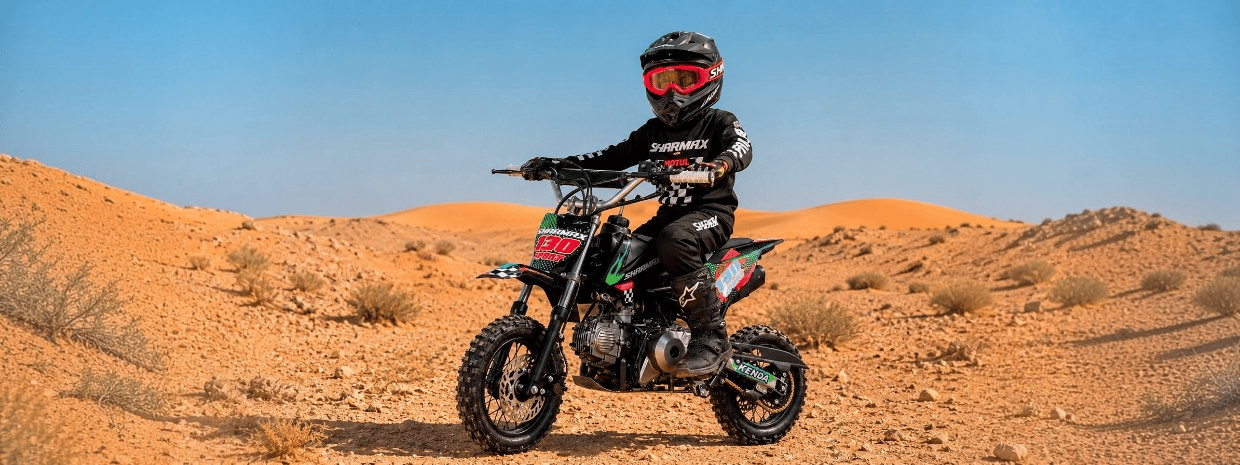
Your ultimate guide to buying a utility ATV in the UAE
Discover your ultimate guide to buying a utility ATV in the UAE, including key features, durability factors, performance, and how to choose the right model.
22 May 2026
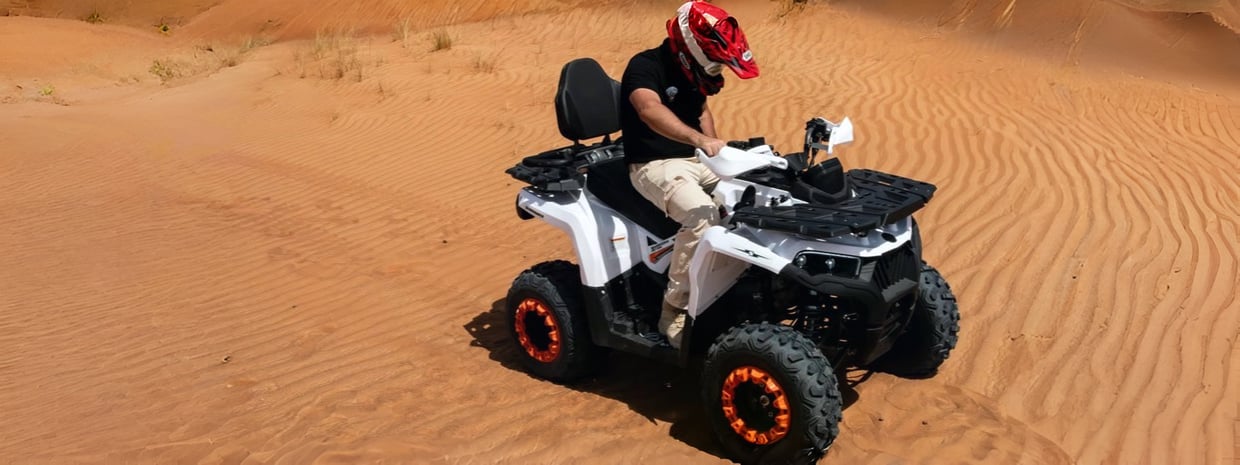
Those days when ATVs for sale were only of interest to a small circle of hardcore off-road fans are long gone. Today, they are widely used in all kinds of practical tasks, not only leisure activities. Among all the off-road four-wheelers, utility ATVs are the recognized do-it-all workhorses that exist for pure function and practicality. Together, we will walk through the main features of a utility quad bike and how to choose one in the UAE with less stress and more expertise.
What is a utility ATV and who is it designed for
As its name suggests, a utility quad bike is built to do various tasks among which racing is not a priority. The primary thing a utility ATV model is expected to do is work in the farm or haul and tow things during hunting or fishing trips.
It’s designed for people who need to:
- carry tools, boxes, feed, or supplies
- tow a small trailer or light equipment
- ride mixed terrain without drama (sand, hardpack, dirt tracks)
- haul everyday loads around a property (water cans, firewood, materials)
- reach remote spots for hunting or fishing without getting stuck every 200 meters.
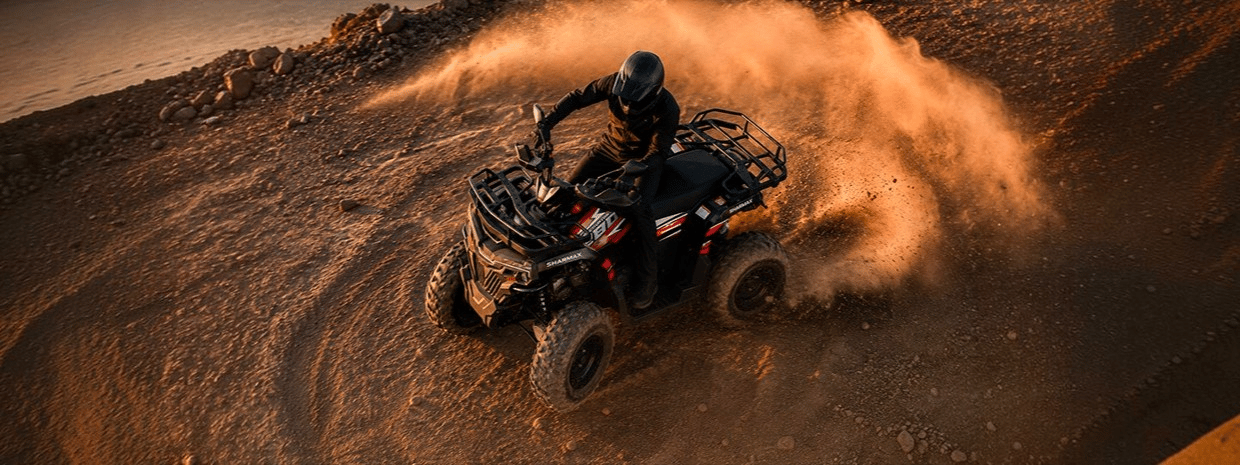
A typical setup of a utility ATV for sale includes front and rear racks, CVT transmission, 2WD/4WD modes, and work-friendly torque. Visually, they are larger than sports models and look more square in form.
Why utility ATVs are popular in the UAE
An ATV utility vehicle in the UAE fits real daily logistics in all kinds of settings. On large private properties, it’s the quick “10–30 km a day” helper for moving tools and supplies without beating up a car.
At desert camps, a 4WD quad helps haul water cans and boxes across soft sand without constant digging.
On camel farms, low-speed pulling power and a rear rack around 60–90 kg make feed and maintenance runs noticeably faster.
For maintenance crews, features like EPS and a 2500–3500 lb winch turn the ATV into a reliable work companion when routes include sand pockets, ruts, or construction debris, which is exactly what many buyers expect when they look for a utility ATV for sale.
How to choose the right utility ATV
Choosing a utility ATV is mostly about matching your tasks to the numbers you’ll actually use: engine size, payload, towing, clearance, and drivetrain. Price matters too, especially in the UAE, where the market starts from around AED 12,000 for entry-level models like the Sharmax Hummer 320 RX LTD and goes up to AED 42,000 for big-bore workhorses like the Sharmax Force 1100 EFI EPS.
Defining your primary riding purpose
Start by being honest about where the ATV will live most of the time because sand, farms, construction sites, and private property routes demand different setups.
- Farm / camel farm chores: hauling feed, tools, water tanks, towing a small trailer. Look for payload around 150–200 kg, towing 300–750 kg, and clearance 250 mm+ so the ATV doesn’t scrape over ruts.
- Desert camps and sand logistics: soft sand needs flotation and traction more than speed. You’ll want 4WD, ideally a lock mode, plus clearance closer to 300 mm for deeper tracks (for example, Sharmax Force 650 has 310 mm, while Sharmax Force 1100 has 360 mm).
- Hunting / fishing access rides: you want controlled low-speed pull, stable brakes, and space for gear—think rear rack capacity and a winch (typical useful range: 2500–3500 lb) for self-recovery.
- Private property + light construction help: regular short-distance movement of tools and supplies benefits from EPS (less fatigue), racks, and towing for small equipment.
If you’re scanning a utility ATV for sale, the fastest way to avoid regret is to pick your primary use case (farm vs sand vs mixed chores), then choose specs that support it.
Choosing the right engine size and power
Engine size is all about how easily the ATV utility vehicle in the UAE moves under load in heat and sand.
A simple working range looks like this:
- 250–350cc: good for light chores, short trips, smaller loads (example: Sharmax Hummer 320 RX LTD is 286cc / 25 hp).
- 450–700cc: the “work + play” sweet spot for most people (example: Sharmax Force 650 EFI EPS is 570cc / 44 hp).
- 900–1100cc: for heavier hauling, deeper terrain, and heavy towing routines (example: Sharmax Force 1100 EFI EPS is 976cc / 92.5 hp).
A good practical rule: if you tow regularly or ride soft sand with cargo, stepping from the 300cc class into the 500–700cc class usually makes the ATV feel calmer and more capable under load.
Understanding towing and cargo capacity
This is where buyers often make the wrong call: they compare engine size, but forget the ATV still has to carry and pull.
For real utility work, check three numbers:
- Payload: many utility setups are comfortable around 150–200 kg (rider + cargo).
- Racks: practical work racks commonly carry something like 30–45 kg front and 60–90 kg rear (varies by model, but those are realistic “workable” targets).
- Towing: for property and farm use, towing often falls in the 300–750 kg range depending on the ATV and trailer.
One practical tip: before you buy, estimate your “real load” in kilograms (you + gear + tools), then make sure you still have a safe buffer of 20–30% because in sand and heat, an overloaded ATV feels slower, runs hotter, and wears parts faster.
Selecting the right drivetrain and traction system
In the UAE, traction is the “quiet hero” spec, especially if your routes include soft sand, loose dirt, and rutted access roads.
Here’s how to think about it:
- 2WD is fine for hardpack and basic property riding.
- 4WD matters when the rear starts spinning—sand, loose gravel, ruts, and towing starts.
- 4WD Lock / differential lock is the “get out of trouble” button for deep sand pockets and muddy ruts (especially with a trailer).
If you’re choosing an ATV utility vehicle UAE riders can depend on year-round, prioritize drivetrain over top speed. In real work use, a stable 60–90 km/h machine with proper 4WD traction is more valuable than higher speed you rarely use.
✅ Use the “Compare” function in the Sharmax online ATV catalog to compare the specs of several models at once.
Key features to look for in a utility ATV
A good utility ATV is basically a tool with wheels. Look at the specs that support the efficiency of these vehicles.
Suspension and ground clearance
A practical target is 250 mm+ of clearance for light mixed use, while serious work setups often sit around 300–360 mm. When you compare a utility ATV for sale, look for independent suspension and realistic numbers of 200–240 mm of travel.
Quick checklist:
- Clearance: 250 mm minimum, 250–310 mm better for ruts/sand
- Suspension travel (rough target): ~200–240 mm
- Add-ons that matter: skid plate thickness around 3–4 mm is a practical “farm/desert” baseline
Tire types for desert and mixed terrain
In sand, tires decide whether you ride forward or dig down. Most UAE-friendly setups use tire diameters around 25–28 inches, with wider profiles to help flotation on soft sand. For mixed terrain (hardpack + sand + gravel), you want a tread that grips without feeling like it’s fighting the ground all day; deep mud tread is great in soft terrain, but can feel noisy and heavy on hard surfaces.
Practical pointers:
- Desert/mixed use size: 25–28 in tires
- Consider beadlocks if you often lower tire pressure for sand (helps prevent tire slip)
- Keep a pressure routine: lower for soft sand, higher for hardpack (within safe manufacturer guidance)
Storage racks and cargo solutions
This is where the “utility” part becomes real. Many buyers forget that payload is not magic—your racks have limits too. A practical working target is about 30–45 kg front and 60–90 kg rear, plus a secure cargo box or net so tools don’t bounce off on the first rough patch. If you’re looking at ATV utility vehicles for sale, prioritize racks, tie-down points, and a proper tow hitch over cosmetic extras.
What to look for:
- Rack rating targets: 30–45 kg front, 60–90 kg rear
- Hitch rating that matches your trailer needs: towing often falls in 300–750 kg range
- Cargo control: hard box + straps beats “hope and gravity”
Fuel capacity and riding range
Fuel range in the UAE changes fast depending on sand. Many utility ATV models carry 10–20 liters of fuel, but “how far that goes” depends on terrain and load. On firmer ground, a realistic range can be 150–250 km; in soft sand with cargo or towing, it can drop closer to 80–150 km. If your routine includes long desert routes, range matters as much as horsepower because walking back is a terrible cardio plan.
Quick checklist:
- Tank: 10–20 L typical
- Range estimate: 150–250 km (easy terrain), 80–150 km (sand + load)
- Smart add-on: fuel can mounts (properly secured) for longer runs
Safety and rider-assistance features
Rider fatigue can be a safety issue, especially with heat and long routes, so assistance features are not “luxury” when you compare utility ATV for sale options. EPS (power steering) reduces arm strain, especially when turning in sand, and good lighting matters when work starts early or ends late. A winch rated around 2500–3500 lb is also one of the most useful safety tools: it’s for recovery, not style.
Look for:
- EPS (especially for sand + loaded steering)
- Strong brakes and predictable throttle response
- Lighting: bright LED setups for dawn/dusk
- Winch: 2500–3500 lb for self-recovery
- Protection: skid plate and bumpers to reduce damage from debris
Common mistakes to avoid when buying a utility ATV
Buying engine size instead of buying capability
People pick “bigger cc” but ignore payload and towing; once you exceed a typical 150–200 kg working payload, the ATV runs hotter and wears faster.
Choosing 2WD in the UAE “to save money”
A utility ATV for sale may look fine in 2WD, but in soft sand and when towing, 4WD (and ideally diff lock) matters more than top speed.
Not checking rack limits separately from payload
Many riders assume “payload 200 kg” means the racks can take anything, but practical rack targets are often around 30–45 kg front and 60–90 kg rear—go beyond that and things bend, crack, or handle poorly.
Overestimating towing in real terrain
A brochure towing range like 300–750 kg is not the same as towing in soft sand; if you tow often, plan for proper hitch setup and recovery (winch 2500–3500 lb).
Picking the wrong tires for sand vs mixed terrain
Many ATV utility vehicle in the UAE setups work best around 25–28 inch tires; the wrong tread/pressure approach can turn every stop into a digging session.
Ignoring clearance and underbody protection
The jump from 200 mm to 300 mm clearance is huge on ruts, and a skid plate around 3–4 mm can prevent expensive underside damage.
Buying used without checking the UAE “wear points”
In utility ATV sales, the costly surprises are usually CVT belt/clutch wear, clogged cooling, worn suspension joints, and dusty intake problems—exactly what can eat your “saved” money after purchase.