Power Max 145 vs Power Max 320: Key Differences Every Rider Should Know in Oman
Compare Power Max 145 and Power Max 320 in Oman. Learn the key differences in engine power, handling, comfort, and features to choose the right motorcycle.
25 Sep 2026
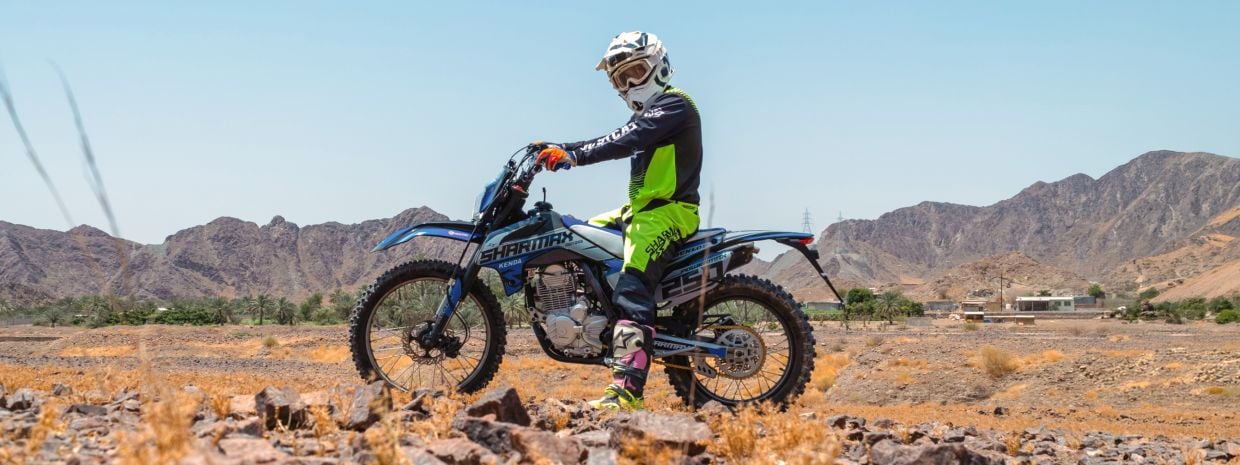
Sharmax has developed its enduro lineup specifically for tough off-road riding across the varied terrain of the Middle East. For riders exploring off-road motorcycles for sale, the Power Max range covers several levels of experience and intensity. It starts with smaller 125 cc pit bikes and extends to full-size hard-hobby enduro models. Two of the most interesting models to compare are the Power Max 250 and Power Max 320. Both sit in the hobby enduro category but with some distinctions.
This Power Max 250 vs Power Max 320 comparison guide looks first at what makes a strong off-road motorcycle, then walks you through the specs side by side to see how these two models approach the same terrain in different ways.
What should you expect from a good off-road enduro?
A few things separate a capable off-road bike from a simply dual-purpose one.
Manageable weight
Off-road riding is physical. A lighter bike is easier to correct when the surface changes. It is also easier to turn around on a narrow trail. If the bike goes down, lower weight makes the next few minutes less painful. For newer riders, weight often matters more than power.
Ground clearance
Rocks, ruts, and washed-out trail sections don't forgive a low-slung chassis. 300mm or more gives real breathing room to clear obstacles without constantly worrying about the underside taking a hit.
Engine output
Enduro riding demands usable low-end torque more than outright top speed — climbing loose inclines and powering through soft sand both call for an engine that responds immediately, not one that needs to be wound out to feel alive.
Long-travel suspension
Long-travel suspension, generally in the 250–280 mm range front and rear, is what actually absorbs the hits on rough trail sections. Just as important as the travel number is how much of it is adjustable — a bike that lets you dial in compression and rebound separately adapts far better to changing terrain than one with fixed damping.
Wheels and tires
A 21-inch front and 18-inch rear wheel combination is the enduro standard for good reason — the larger front wheel rolls over obstacles more smoothly, while the 18-inch rear balances traction and durability.
Frame and chassis material
Chromoly steel alloy frames are common in this class because they hold up to repeated impact stress better than standard steel, without adding unnecessary weight.
Cooling
Air cooling is simple and easy to maintain. Liquid cooling gives more thermal control when the bike is ridden harder. It is especially useful in hot weather, slow technical riding, and repeated load. Neither setup is automatically better for everyone. It depends on how hard the bike will be used.
Power Max 250 and Power Max 320 comparison: what they have in common
Before getting into what separates them, it's worth seeing how much of the same core platform both bikes actually share. Both models clearly belong to the same general enduro direction.
Both models use:
- a chromoly steel alloy frame
- 270 mm front and 280 mm rear suspension travel
- a 21/18-inch wheel setup
- KMC 520 GOLD chain with a 43-tooth sprocket
- a 5-speed gearbox
- combined electric and kick starter
- a 300mm ground clearance and 890mm seat height
So, the difference between the two isn't found in the basic chassis architecture. Both bikes share the same core dimensions and suspension travel figures. The real separation shows up in the engine, the cooling system, and a handful of equipment details.
The difference between Power Max 250 and Power Max 320
Power Max 250 vs Power Max 320 engine
The engine is where the comparison starts to separate clearly.
| Specification | PM 250 | PM 320 |
|---|---|---|
| Engine model | ZS172FMM-3A | ZS174MN |
| Displacement | 250 cc | 300 cc |
| Power | 21 hp | 27 hp |
| Cooling | Air-cooled | Liquid-cooled |
| Fuel system | Nibbi PE30 carburetor | NIBBI PWK 34 racing carburetor |
When comparing the Power Max 250 vs Power Max 320 engine, the cooling system is arguably the more significant difference, not just the extra 6 hp. Liquid cooling on the 320 keeps operating temperature more stable during sustained low-speed, high-load riding — exactly the kind of riding that punishes air-cooled engines most, climbing soft sand or grinding through a rocky section at low RPM.
Power Max 250 vs Power Max 320 performance
The Nibbi PWK34 Racing carburetor on the 320 is also a genuine step up in tuning ambition — it's a performance-oriented unit built for more aggressive throttle response, not just a bigger-bore version of the 250's PE30. For riders who spend real time on technical trails rather than gentle loops, that difference in throttle character is noticeable in a way the horsepower number alone doesn't capture.
So the choice is fairly simple. Choose the 250 engine if you want something simpler and lighter. Choose the 320 engine if you want more power and a more serious off-road feel.
Suspension and chassis: where both bikes get serious
Both models use serious long-travel suspension, with 270 mm of front travel and 280 mm at the rear. The difference is not in travel, but in how much control the rider gets over the setup.
| Specification | PM 250 | PM 320 |
|---|---|---|
| Front suspension adjustment | Rebound damping | Compression and rebound damping |
| Rear suspension adjustment | Compression, rebound, spring preload | Compression, rebound, spring preload |
| Front travel | 270 mm | 270 mm |
| Rear travel | 280 mm | 280 mm |
| Ground clearance | 300 mm | 300 mm |
Where they do differ is suspension adjustability: the 320's front fork offers both compression and rebound damping adjustment, while the 250's front end is limited to rebound only. That gives the 320 noticeably more room to fine-tune the ride as terrain changes, which matters more the longer and rougher the trail gets.
The basic takeaway is clear. The Power Max 250 gives you serious off-road hardware in a lighter package. The Power Max 320 keeps the same travel and clearance, then adds more tuning potential.
For a deeper look at what those settings actually do, read our guide on how to adjust suspension on an enduro motorcycle.
Wheels and tires
Both bikes use the same wheel size, but the tire brands differ.
| Specification | PM 250 | PM 320 |
|---|---|---|
| Front tire | Yuanxing 80/100-21 | Kenda 80/100-21 |
| Rear tire | Yuanxing 110/90-18 | Kenda 110/90-18 |
| Wheel size | 21/18 | 21/18 |
| Rim material | Aluminum alloy | Aluminum alloy |
The 21/18 setup is one of the most important shared Power Max 250 features and Power Max 320 features.
It gives both bikes the correct base for enduro-style use. The larger front wheel helps over rough ground. The 18-inch rear fits the off-road role better than a more road-biased setup.
The Power Max 320’s Kenda tires also support its more performance-focused positioning.
Dimensions and comfort
| Specification | PM 250 | PM 320 |
|---|---|---|
| Length | 2,180 mm | 2,180 mm |
| Width | 820 mm | 890 mm |
| Height | 1,240 mm | 1,240 mm |
| Seat height | 890 mm | 890 mm |
| Ground clearance | 300 mm | 300 mm |
| Wheelbase | 1,390 mm | 1,490 mm |
| Curb weight | 102 kg | 120 kg |
The real differences show up in width, wheelbase, and weight. The 320 is 70 mm wider and rides on a wheelbase 100 mm longer than the 250, giving it a more planted, stable feel at speed and through faster sections of trail. The 250's shorter wheelbase and narrower frame make it quicker to flick through tight, technical terrain where agility matters more than outright stability.
The 18 kg weight difference is worth noting too — at 102 kg, the 250 is a genuinely lighter machine to muscle around at low speed or pick up after a fall, while the 320's extra mass comes largely from its bigger engine and liquid cooling system rather than added bulk anywhere else.
This is where the Power Max 250 vs Power Max 320 comfort question becomes more about control than softness.
The 250 model may feel more comfortable for riders who want less weight to manage. The 320 may suit riders who prefer a larger, stronger bike and already have more confidence off-road.
Equipment and practical details
The equipment list also shows the difference between the two models.
| Feature | PM 250 | PM 320 |
|---|---|---|
| Fuel tank | 9 L | 7 L |
| Handlebar | Aluminum 22/28 Fatbar | Aluminum thick-wall 28/22 Fatbar |
| Handguards | Yes | Yes |
| Stop signal | Yes | Yes |
| Dashboard | Yes | Yes |
| Engine protection | No | Yes |
| Brake disc protection | No | Yes |
The first one has the larger fuel tank at 9 liters. That gives it an advantage for longer rides away from fuel stops.
The Power Max 320 has more protection equipment listed. It includes engine protection and brake disc protection. That fits its harder off-road positioning.
The handlebar setup differs too — the 320 uses a thicker, dual-section 28/22 Fatbar, while the 250 runs a standard aluminum 22/28 Fatbar. Riders spending long days standing on the pegs over rough terrain will likely notice the 320's setup holds up better to sustained stress.
The 250 leans toward lighter, simpler hard-hobby use. The 320 leans toward stronger and more aggressive riding.
Power Max 250 vs Power Max 320 price
The Power Max 250 vs Power Max 320 price gap in Oman is OMR 300. For the extra OMR 300, the Power Max 320 adds a 300 cc-class engine, 27 hp instead of 21 hp, liquid cooling, a NIBBI PWK 34 Racing carburetor, more front suspension adjustment, Kenda tires, engine protection, and brake disc protection.
The Power Max 250 remains the more accessible choice. It keeps the same full-size enduro stance, with 21/18 wheels, 300 mm ground clearance, and long-travel suspension, but in a lighter and simpler air-cooled format.
Which is better: Power Max 250 or Power Max 320?
There's no universal winner as the two bikes suit slightly different riders and riding styles.
Choose the Power Max 250 if you want:
- a lighter full-size enduro bike;
- simpler air-cooled mechanics;
- 21/18 wheels;
- 300 mm ground clearance;
- long-travel suspension;
- a larger 9-liter fuel tank;
- a bike that feels less demanding in slow sections.
This is the easier bike to approach. It still has serious off-road geometry, but it does not ask for the same level of strength or confidence as the 320.
It makes more sense for riders who want a full-size hobby enduro that stays lighter and simpler.
Choose the Power Max 320 if you want:
- more power;
- liquid cooling;
- a stronger engine character;
- a more performance-focused carburetor;
- front compression and rebound adjustment;
- engine and brake disc protection;
- a bike better suited to harder off-road use.
Definitely the more advanced option. It has more output and more serious equipment, but it also carries more weight.
It is the better fit for riders who want more engine, more cooling capacity, and a setup that feels closer to hard hobby enduro. It is stronger and more equipped, but it will also feel heavier.
So which is better: Power Max 250 or Power Max 320 depends on how hard the bike will be
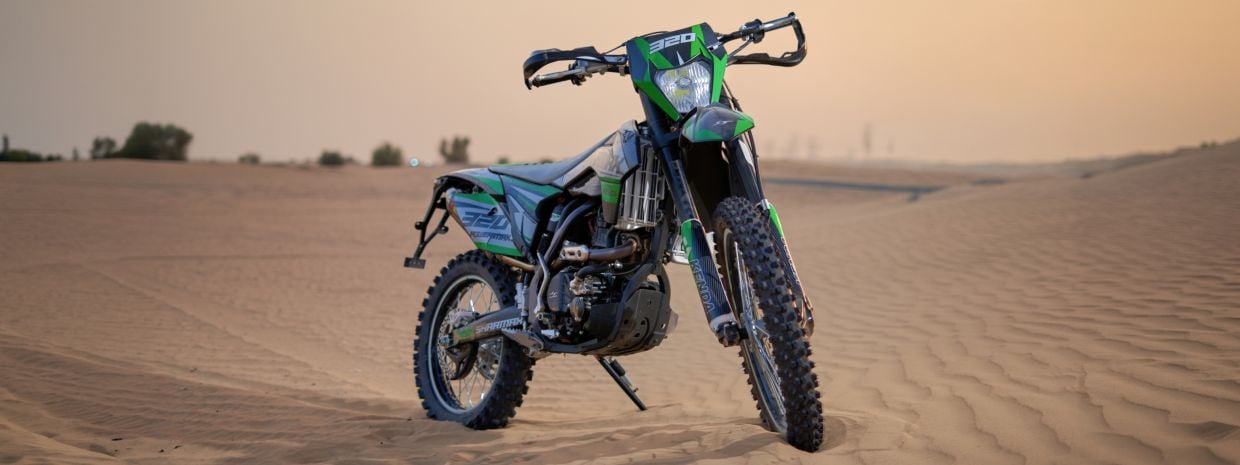
Find your enduro match at Sharmax
The best way to choose between the Power Max 250 and Power Max 320 is to see how each one feels in person. Visit the Sharmax showroom, compare both models side by side, and talk through your riding style and terrain with the team before deciding. Book a test ride to feel the difference in throttle response and suspension firsthand.