Cruiser vs Sportbike vs Dirt Motorbike in Oman
Ask five riders in Muscat which bike is “best” and you’ll probably get ten answers. The country itself encourages all riding styles, and to really experience all sides of life in Oman, one motorcycle is rarely enough. Cruisers, sportbikes and dirt bikes each shine in their own environment
20 Feb 2026
Below, we’ll break down three motorcycle types – cruiser vs sportbike vs dirt bike – and explain how a rider can decide which one deserves the top spot in their garage right now.
Overview of motorcycle types
Cruiser: comfort and style
A cruiser is the relaxed side of riding: low seat, laid-back ergonomics and a lot of style. When people talk about cruiser motorcycle vs sportbike, they’re really comparing comfort and attitude versus aggression and speed. In the Sharmax line-up, a roadster-style model like the Custom 1000 RST bike gives that custom look but stays usable for real city and highway riding.
Pros
- From the cruiser motorbike pros and cons angle, cruisers win on comfort, low seat height and stability on long, straight highways.
- They’re easy to flat-foot in traffic, carry a passenger comfortably and look right at home in front of cafés and along the corniche.
Cons
- The trade-off is agility and ground clearance. In tight corners and mountain roads, the difference between sportbike and cruiser becomes obvious: they’re heavier, slower to turn and run out of lean angle early.
- In very hot traffic, big cruiser engines can also feel hotter and more tiring than lighter bikes.
Sportbike: pure performance
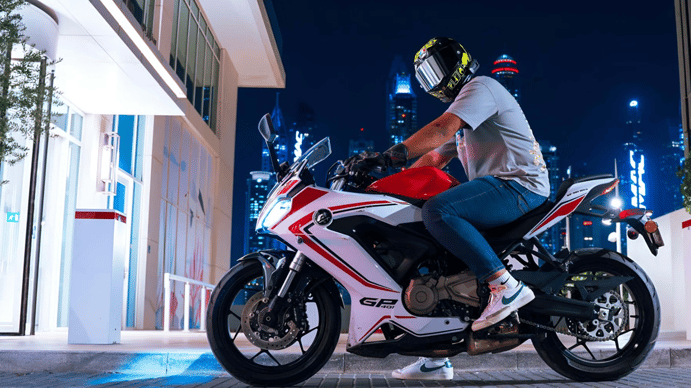
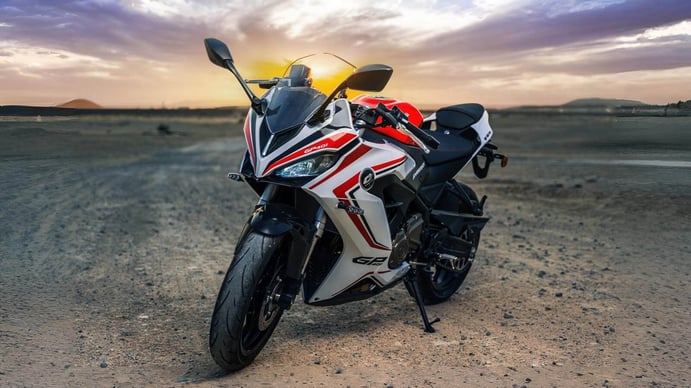
A sportbike is built for speed, late braking and fast direction changes. It demands more from the rider than a cruiser but pays back with sharper reactions and higher performance. An outstanding Sharmax example would be a GP-style model like the GP 1100 Ultra, aimed at riders who dream about track days and fast weekend runs.
Pros
- Looking at sportbike pros and cons, the upside is clear: hard acceleration, strong brakes and precise cornering.
- On good Oman tarmac, a sportbike feels incredibly planted and responsive, especially when you compare cruiser vs sportbike handling on twistier roads.
Cons
- The downside is comfort and cost. The aggressive riding position can hurt wrists and back in slow city traffic, and tyres, brakes and insurance usually cost more than on a comparable cruiser or tourer.
- For mixed city/desert life, they’re also the least versatile option.
Dirt motorbike: serious off-road adventures
A dirt motorbike is light, tall and built to survive crashes, sand and rocks. It’s the natural choice for riders who see Oman as a giant off-road park – dunes, wadis and mountain trails. Sharmax off-road and enduro models are made exactly for this: long-travel suspension, knobbly tyres and simple, rugged engineering.
Pros
- If you look at dirt motorbike pros and cons, the biggest plus is terrain freedom. A dirt bike goes places road machines simply can’t, and falls are cheaper to fix.
- For riders who live for desert mornings and rocky climbs, nothing else feels as capable. For instance, experienced enduro riders will certainly appreciate the Sharmax Expert Pro 450 as a capable off-road machine.
Cons
- On long asphalt stretches, the weaknesses appear. A sportbike vs dirt motorbike comparison on the highway shows more noise, less comfort and less stability from the dirt bike.
- High seat height, small tanks and minimal wind protection also make them a poor choice for everyday commuting or long inter-emirate trips. Besides, most dirt bikes are not road-legal.
Key features compared
Riding position and ergonomics
- Cruiser: relaxed armchair
- Sportbike: forward-leaning, takes getting used to
- Dirt bike: tall and active, you move with the bike
The first thing you feel in the difference between sportbike and cruiser is what happens to your body. On a cruiser you sit low and relaxed, with long, wide bars that make inputs smooth and gradual. It’s easy to counter-steer gently and let the bike roll into the turn at its own pace.
On a sports machine, the same rider suddenly leans forward, puts more weight on the wrists and grips much shorter bars. Small movements now produce big reactions, so the bike “falls” into corners more quickly and the posture definitely takes some getting used to.
Dirt bikes change the picture again: tall seat, very wide bars, and a standing, active stance over bumps and sand. Compared to a cruiser motorcycle vs sportbike, an off-road bike feels more like a tall lever you move with your whole body than a chair you sit in.
Engine performance and speed
- Cruiser: low-rpm torque
- Sportbike: high-rev power hit
- Dirt bike: strong mid-range for climbs
From an engine point of view, a sportbike vs cruiser comparison is really about where the power lives. Cruisers tend to have big, lazy motors with strong low-rpm torque that shove you forward smoothly without many gear changes which is perfect for relaxed highway limits.
Sport machines build power higher up the rev range. They feel fairly calm at low rpm, then surge hard when you twist the throttle, which is fun but also demands discipline. Of course, sport bikes are all about speed – some of them, like the Sharmax GP 881 Ultra can go as fast as 240 km/h.
Dirt bikes do something else entirely: they sacrifice top-end numbers for punchy mid-range so you can climb dunes or snap the front wheel over ruts. On paper, sportbike vs dirt motorbike speed is no contest on tarmac, as the latter is not meant to hit rocket speed. But in the desert the dirt bike is the fastest one simply because it can stay upright and find traction where a pure road bike would sink.
Handling and manoeuvrability
- Cruiser: stable but slow to turn
- Sportbike: sharp and precise
- Dirt bike: loose on tarmac, ultra-agile off-road
When it comes to steering, cruiser vs sportbike handling shows how geometry changes the ride. Long, low cruisers with kicked-out front forks feel very stable in a straight line but ask for more effort to turn; they also run out of lean angle earlier.
Sport machines sit on steeper head angles with firmer suspension, so they tip in quickly and let you change direction with minimal bar input – great for twisty mountain roads but more nervous for some riders at first.
In a sportbike vs dirt motorbike comparison, the off-road bike initially feels vague on smooth asphalt, with soft suspension and narrow tyres, yet becomes far more agile on loose surfaces. In sand or rock, where you constantly correct slides and weight shifts, the dirt bike’s wide bars and long-travel suspension make it the easiest to place exactly where you want it.
Comfort for city and long-distance rides
- Cruiser: best for long straight days
- Sportbike: exciting but tiring
- Dirt bike: fun short bursts, poor for distance
If you look at cruiser motorbike pros and cons from a comfort angle, they’re clear winners for slow city cruising and long, straight highway days: neutral spine, low seat, and an engine that doesn’t ask to be revved.
A hardcore sport machine, by contrast, can feel punishing in stop-and-go traffic, even though it’s brilliant at speed – part of the trade-off hidden inside typical sportbike pros and cons lists. Wrists, neck and lower back all remind you this bike was designed with track pace in mind.
Dirt bikes sit at the extreme end of practicality: amazing for short off-road blasts in Oman’s desert, but tall, buzzy and tiring for everyday commuting or multi-hour inter-emirate rides. That’s why many riders in the region end up with a mixed garage rather than forcing one bike to do everything.
Purchase price comparison
- Cruiser: often most expensive at the top end
- Sportbike: wide price ladder
- Dirt bike: cheap trail bikes, pricey race bikes
When you look at prices in Oman showrooms, the sportbike vs cruiser gap isn’t always huge at the mid-range. For example, a mid-size branded cruiser of similar age used can sit around OMR 2,500–4,000, while big touring cruisers from premium brands can easily go from OMR 7,000 up to 10,000+ in the local market.
Dirt bikes span a wide range too: simple trail or dual-sport models can land in the OMR 1,800–2,800 bracket, while full-spec competition enduro or motocross machines often sit around OMR 3,000–3,800 new before you add guards, skid plates and extras.
So in the real world, “cheap dirt bike, expensive cruiser, middle sportbike” is only partially true – it depends heavily on whether you’re looking at entry-level or high-end in each category.
Fuel efficiency and running costs
- Cruiser: steady and reasonable
- Sportbike: far from being fuel-efficient
- Dirt bike: efficient on paper, thirsty in deep sand
On fuel alone, the picture of dirt motorbike vs sportbike versus cruiser is more about how you ride than what you ride. Typical real-world figures:
- A mid-capacity sportbike is often quoted around 4.8–5.0 L/100 km in mixed use.
- A cruiser of 400-600cc class sits close at roughly 4.6–4.8 L/100 km at moderate speeds.
In early 2026, petrol in Oman (Mogas 95) sits around 0.239 OMR per litre.That translates to roughly 1.15–1.20 OMR in fuel per 100 km for either a cruiser or a mid sport machine when ridden sensibly.
Dirt bikes are often frugal on spec sheets (5–6 L/100 km), but repeated hard acceleration in sand and low gears can push real consumption closer to 6–7 L/100 km, especially with aggressive riding. In Oman, where petrol is still relatively affordable, tyres, chains and brake pads usually dominate running costs: sportbikes wear road tyres and pads fastest, cruisers somewhere in the middle, and off-road machines chew through knobbly tyres and chains every desert season.
Maintenance needs
- Cruiser: long service intervals
- Sportbike: similar, but more complex parts
- Dirt bike: high performance, high maintenance
Maintenance is where the three types truly separate, and here dirt motorbike pros and cons become very obvious.
Road-going cruisers and sport machines typically follow kilometre-based intervals: oil and filter every 6,000–10,000 km, valve checks at wider gaps, and an occasional major service. For many Omani riders, that means a couple of services per year if they ride regularly, which keeps life pretty simple.
Proper competition-style dirt bikes live on a completely different schedule. It’s normal to see hour-based service plans:
- roughly every 10 hours – oil and oil filter change, air filter clean or replace,
- around every 20 hours – greasing suspension linkages, checking valves,
- about every 80–100 hours of hard use – top-end refresh or even full engine rebuild (piston, rings, sometimes cylinder, bearings, etc.).
That level of attention is fantastic if you want maximum off-road performance, but it makes a pure dirt machine a high-commitment tool compared to a cruiser or sportbike you mostly service a few times a year and forget about in between.
Best use cases in Oman
Urban commuting and city traffic
For daily city runs, cruisers and sportbikes in Oman can both cope well with traffic lights, roundabouts and short hops. In this sportbike vs cruiser situation, the choice is mostly about comfort: a milder sportbike or compact cruiser with reasonable ergonomics and cooling is easier to live with than a full race replica, so think about low-speed heat, steering lock and clutch feel before anything else.
Highways and long-distance travel
On long trips the difference between sportbike and cruiser shows in your body, not the spec sheet. From the cruiser motorbike pros and cons point of view, cruisers win here: relaxed ergonomics, better wind comfort and calmer engines make hours of highway riding far easier, while any gains a sportbike has are rarely used on straight multi-lane roads.
Desert and off-road trails
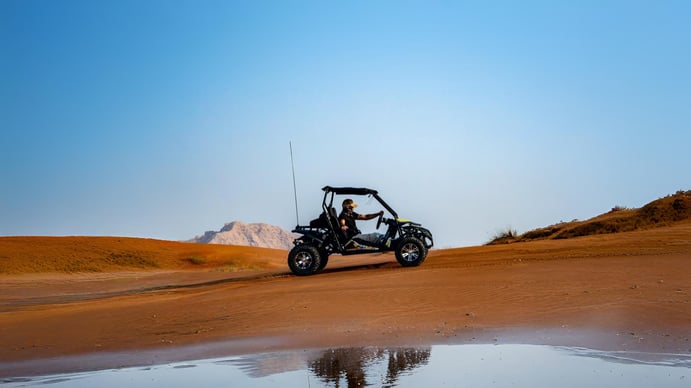
Once you leave the tarmac, cruiser vs dirt motorbike is not a serious contest. In soft sand and rocky wadis, a proper enduro or motocross machine is the only tool that works, which is why riders often keep a Sharmax off-road model next to their road bike. Any sportbike vs dirt motorbike comparison off-road ends quickly: regardless of impressive specs on paper, a lightweight dirt machine will always beat a heavy road bike in real dunes, so most people treat dirt motorbike vs sportbike as a “two-garage” solution rather than an either/or choice.
Frequently asked questions
Can a cruiser handle desert roads?
No, unfortunately not. A typical cruiser can only handle a light level of off-roading. It was built for road use, and if you want to go off the track every now and then, it is better to look for a dual-purpose model rather than a classic cruiser.
Is a sportbike practical for city traffic?
It can be quite practical but with limitations. When the traffic is heavy and during slow rush hours, it can be very tiring on the wrists and back, and heat from the engine and fairings can be uncomfortable in summer.
Can a dirt motorbike be used on public roads?
In most cases no, dirt bikes are not street-legal, except for some modified models. Many dual-sport and enduro models are sold in street-legal versions. Pure motocross bikes without lights or registration are meant for tracks and off-road areas only.
Final thoughts: which motorcycle should you choose in Oman
There’s no universal winner here—only the bike that matches how and where you actually ride.
- If most of your time is on highways and evening coastal runs, a cruiser or relaxed roadster will feel easiest to live with and most comfortable over distance.
- If you dream of track days, fast mountain roads and precise cornering, a sports machine used mainly for weekends and clear-road sessions makes sense.
- If your ideal Oman weekend means sand, rocks and technical climbs, a dirt or serious dual-sport bike is the only tool that will really let you enjoy it.
Many riders eventually end up with two bikes—a road-oriented machine plus a dedicated off-road one—rather than forcing a single motorcycle to do everything. Start with the type that fits 70–80% of your riding, learn what you truly enjoy in local conditions, and let your next bike follow from that experience, not just from the spec sheet or the showroom lights.