Buying a Utility ATV in Egypt
Compare utility ATVs by intended work, load limits, towing specifications and equipment. Choose a model suited to your tasks and terrain in Egypt.
02 Sep 2026
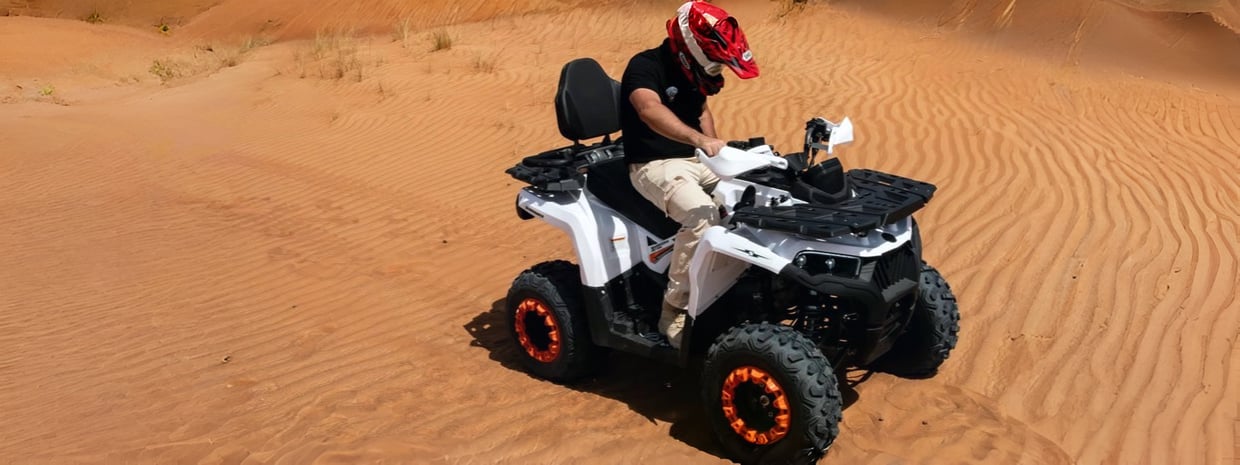
The days when ATVs were only for a small group of off-road driving enthusiasts are over. Today, these vehicles are widely used for various practical tasks, not just recreational activities. Among all the ATVs designed for off-road use, multi-purpose four-wheel drives are the ideal choice, as they are designed to perform their functions with high efficiency. Together, we will review the most important features of multi-purpose ATVs and how to easily choose the most suitable one in Egypt.
What is an all-purpose ATV and who is it designed for?
As its name suggests, the all-terrain quad bike is designed for a variety of tasks, with racing not being its primary focus. Its main purpose is agricultural work or transporting and towing equipment during hunting trips.
This product is designed for people who need:
- Carry tools, boxes, feed, or supplies
- Towing a small trailer or light equipment
- Navigating diverse terrains, with a choice of equipment and speed suitable for each surface.
- Moving daily loads around the property (water cans, firewood, materials)
- Access to work areas or outdoor activities via permitted routes
Typical features of the ATVs for sale include front and rear racks, a CVT transmission, two-wheel and four-wheel drive options, and heavy-duty torque. They are larger than sport models and have a boxy design.
Where are quad bikes practical in Egypt?
The practical ATV serves everyday tasks on properties, farms, and large sites, such as transporting tools and supplies between work points. It reduces the need for a larger vehicle for short trips, provided the load and route are compatible with its capabilities.
In camps and sandy locations, they can be used to transport light supplies with appropriate tires and fittings. Deep sand and heavy loads affect performance, and four-wheel drive alone does not guarantee a stable ride.
On farms, low-speed torque and racks help transport maintenance tools and feed, within the approved load for each rack and for the entire vehicle.
For maintenance crews, features such as an electric power steering (EPS) system and a 2,500-3,500 lb towing winch turn an ATV into a reliable work companion when roads include sand pockets, ditches, or construction debris, which is exactly what many buyers expect when they are looking for a versatile ATV for sale.
How to choose the right multi-purpose ATV
The choice depends on matching the job with the engine capacity, payload, towing capacity, ground clearance, and drivetrain. Compare a lightweight model like the Hummer 320 RX LTD with a larger one like the Force 1100 in terms of both the task and the overall cost. Get a current price in Egyptian pounds that includes the agreed-upon equipment and services, rather than relying on offers from another market.
Determine the primary purpose of your ride
Start by being honest about where the ATV will be most of the time, because sand, farms, construction sites and private property roads require different equipment.
- For agricultural work: Determine the weight of feed, tools, trailer, and travel distance. In the examples here, the total payload is 250–280 kg for some Force models, and the towing capacity is 400–750 kg depending on the model; these are not uniform limits for all ATVs.
- Camping and sand: Compare the tires, traction, and ground clearance with the track. The Force 650 has approximately 310 mm of clearance, and the Force 1100 has approximately 360 mm. A differential lock may be helpful in certain conditions; use it as directed.
- Accessing outdoor activity areas: Focus on low-speed control, braking, and equipment space. The winch requires proper anchor points and training; a difficult route does not automatically make it safe.
- Private ownership + assistance with light construction work: Regular short-distance transport of tools and supplies benefits from the EPS (less stress) system, racks, and towing for small equipment.
If you are looking for a multi-purpose vehicle for sale, the quickest way to avoid regret is to choose your primary use case (farm vs. sand vs. mixed work), and then choose the specifications that support it.
Choosing the right engine size and power
Engine capacity affects performance under load, but it's not the only factor. The drivetrain, cooling system, transmission ratios, and load limits are equally important in hot and sandy conditions.
The scope of a simple task looks like this:
- The 250–350 cm³ category includes options for light tasks and short trips, such as the Hummer 320 RX LTD with a 286 cm³ engine and 23 horsepower.
- The 450-700 cm³ category: Some of its models combine work and travel, such as the Force 650 EFI EPS with a 570 cm³ engine and 44 horsepower.
- Larger models offer additional power for advanced applications, such as the Force 1100 with its 976cc engine and 92.5 hp. Towing and payload limits remain independent of the power figure.
If you're constantly towing or working on soft sand, compare the engine's power with its cooling, traction and towing limits. Upgrading to a higher class might be beneficial, but it's not a substitute for matching the vehicle to the task.
Understanding towing and payload capacity
This is where buyers often make a mistake: they compare engine size, but they forget that a ATV still needs to carry and pull things.
For real utility work, check three numbers:
- Total payload: Includes the weight of the rider, passengers, and equipment as defined by the manufacturer; for example, 250 kg for the Force 650.
- Cargo racks: Their limits are independent; the Force 650 can hold about 35 kg in front and 50 kg in the back, while the limits in the Force 1100 are about 45 and 90 kg.
- Towing: Determine the total weight of the loaded trailer, then compare it to the vehicle and coupling limits. Example: 400 kg for the Force 650 and 750 kg for the Force 1100, under approved operating conditions.
Before purchasing, calculate the actual load capacity instead of guessing, and allow for a reasonable margin for additional equipment. Do not exceed the approved limit; sand and slopes may necessitate further load reduction as per the operating instructions.
Choosing the appropriate transmission and traction system
In Egypt, traction power is considered the "silent hero" specification, especially if your roads include soft sand, loose soil, and rough access roads.
Here's how to think about it:
- Two-wheel drive may suit firm tracks and light-duty routes; it does not establish public-road approval.
- Four-wheel drive can help increase traction on loose surfaces, when activated in the manner and at the speed specified in the manual.
- The differential lock is a tool for navigating specific situations, not a guaranteed rescue button. It may alter the steering, so use it only as instructed by your model.
In a work vehicle, prioritize low-speed control, braking, traction and load handling. The advertised maximum speed is not a suitable operating speed for hauling or towing.
Compare the models in the Sharmax quad bike catalog, and assign to each the required task and load.
Key features to look for in a versatile ATV
A good all-wheel-drive vehicle is essentially a tool with wheels. Look at the specifications that support the efficiency of these vehicles.
Suspension system and ground clearance
Ground clearance and suspension help the vehicle traverse ruts without frequent scraping. Compare the actual figures: the Hummer 320 RX LTD has 300 mm of ground clearance, while the Force 650 has approximately 310 mm, despite the different suspension designs. Height alone is not enough to judge comfort or stability.
Quick checklist:
- Ground clearance: Compare it to the depth of ruts and obstacles on your route, not to a general minimum.
- Suspension travel: For example, the Force 650 has 180 mm front and 210 mm rear; compare the design and adjustment as well.
- Undercarriage protection: Check the material, coverage, mounting points, and model compatibility, not just the thickness.
Types of tires suitable for desert and mixed terrain
In sand, tire size, tread pattern, and pressure all affect buoyancy and grip. Larger tires aren't always better; they can alter the load on the transmission, clearance, and steering. For example, the Force 650 uses 25x8-12 front and 25x10-12 rear tires. For mixed trails, choose a tread pattern appropriate for the prevailing surface rather than fitting a very deep mud tire simply for its appearance.
Practical tips:
- Size: Use the approved model sizes and appropriate load indicators.
- A beadlock wheel mechanically secures the tyre bead to the rim. It does not justify reducing tyre pressure arbitrarily; use approved equipment and follow the specified pressure limits.
- Pressure: Check it cold with a low-pressure gauge, and follow the approved values for the vehicle, load, and surface.
Cargo Racks and Carrying Solutions
Each cargo rack has its own load limit, even if the overall load is higher. The Force 650 allows for 35 kg in front and 50 kg in the rear, while the Force 1100 offers limits of 45 kg and 90 kg. Secure boxes and tools with appropriate straps, and distribute the weight evenly and effectively. Proper tie-down points and connections are more important than cosmetic accessories that don't serve your purpose.
What to look for:
- Rack limits: Check them for the selected model and include them in the total load.
- Towing capacity: Match the vehicle's limit and connection with the loaded trailer and track conditions.
- Load control: A rigid box + straps overcomes "hope and gravity"
Fuel tank capacity and driving range
Fuel range varies depending on sand, load, towing capacity, and driving style. The Hummer 320 RX LTD has an 8-liter tank, the Force 650 has 20 liters, and the Force 1100 has 25 liters. Don't interpret tank capacity as a guarantee of a fixed mileage: track your consumption in similar situations and plan your return trip with a suitable reserve. Long journeys also require communication and a support plan, not just fuel.
Quick checklist:
- Tank capacity: Compare to the actual value; examples here range between 8 and 25 liters.
- Range: Calculate it from consumption measured under similar conditions, with a reserve for return.
- Additional fuel: Only in approved containers, secured according to transport instructions and away from heat sources.
Safety Features and Rider Assistance
Driver fatigue can pose a safety risk, especially in extreme heat and over long distances, so assistance features aren't a luxury when comparing the options available on ATVs. Electric power steering (EPS) reduces arm strain, particularly when turning in sand, and good lighting is essential when starting early or finishing late. A winch with a capacity of 2,500 to 3,500 pounds is a crucial safety feature: it's for rescue, not for show.
Look for:
- Electric power steering to reduce steering effort.
- Powerful brakes and predictable throttle response
- Lighting: Bright LED lighting fixtures for dawn/dusk
- Winch: an example rating of 2,500–3,500 lb pulling force for vehicle recovery; select the equipment and method for the ATV, not as a lifting capacity.
- Protection: Skid plate and bumpers to reduce damage from debris
Common mistakes to avoid when buying a utility ATV
Buying engine size instead of buying capability
A bigger engine does not increase the vehicle’s approved payload or towing limit. For example, a working load of 150–200 kg may already approach or exceed the limit of a particular model. Compare the permitted load, including the rider, accessories and cargo, before choosing by displacement.
Choosing 2WD in Egypt just to save money
Two-wheel drive can suit light work on firm tracks, while 4WD and an appropriate differential-lock system can matter more than top speed in soft sand or demanding work. Choose the drivetrain for the actual terrain and the manufacturer’s towing limits.
Not checking rack limits separately from payload
A total payload of 200 kg does not mean the racks can carry 200 kg. A specification might, for example, allow 30–45 kg at the front and 60–90 kg at the rear, but these are illustrative figures, not universal limits. Use the exact front-rack, rear-rack and total limits for your ATV; overloading can damage the racks and impair handling.
Overestimating towing in real terrain
An advertised towing capacity such as 300–750 kg does not describe every situation in soft sand or on slopes. Follow the model’s conditions for trailer weight, hitch load and braking. A winch rated at 2,500–3,500 lb is an example of recovery equipment, not extra towing capacity or permission to lift loads; match the winch and recovery method to the vehicle.
Picking the wrong tyres for sand or mixed terrain
Tyres around 25–28 inches appear on many utility ATVs, but diameter alone does not establish compatibility. Use an approved size, tread and cold pressure for the load and terrain. The wrong setup can impair control and increase drivetrain stress instead of helping in sand.
Ignoring clearance and underbody protection
The difference between 200 mm and 300 mm of clearance can matter in ruts. A skid plate around 3–4 mm thick is another comparison point, but material, coverage and mounting are just as important. Choose protection designed for the model rather than thickness alone.
Buying used without checking Egypt’s wear points
The costly surprises are often CVT belt or clutch wear, clogged cooling, worn suspension joints and dust entering the intake. Inspect these systems before buying: otherwise, the money saved on the purchase can quickly disappear into repairs.
Frequently Asked Questions
What is the most suitable engine size for a versatile ATV?
Start by considering the task, payload, and drivetrain. A model close to 300 cc might suffice for light work, while the 500–700 cc range offers more options for more varied tasks. Don't base your choice solely on capacity.
What is the maximum weight a multi-purpose ATV can carry?
Load capacity varies by model. For example, the total limit for the Force 650 is 250 kg, and for the Force 1100 it is 280 kg. These limits include passengers and equipment as per the manual, with separate limits for each rack.
How often should a ATV be serviced?
Follow the model schedule based on engine hours, mileage, or time, whichever comes first. Break-in servicing varies by model, and dust and sand may necessitate more frequent filter and cooling checks.
What is the average lifespan of a multi-purpose ATV?
With regular maintenance, many versatile four-wheel-drive vehicles can operate for thousands of hours; however, in harsh sand conditions, their lifespan depends heavily on the efficiency of the air filtration system, the cooling system, and the maintenance of the continuously variable transmission (CVT). In practice, regular maintenance is more important than the vehicle's lifespan.
Can beginners drive ATVs safely?
A beginner can learn on a model appropriate to their age, size, and experience, after practical training and with protective equipment. Guidance does not replace training; start without pulling or additional loads and in a suitable space.