Choose an Enduro Bike by Height & Weight
Learn how rider height and weight affect enduro bike fit. Compare seat height, reach and suspension setup for better comfort and control.
21 Aug 2026
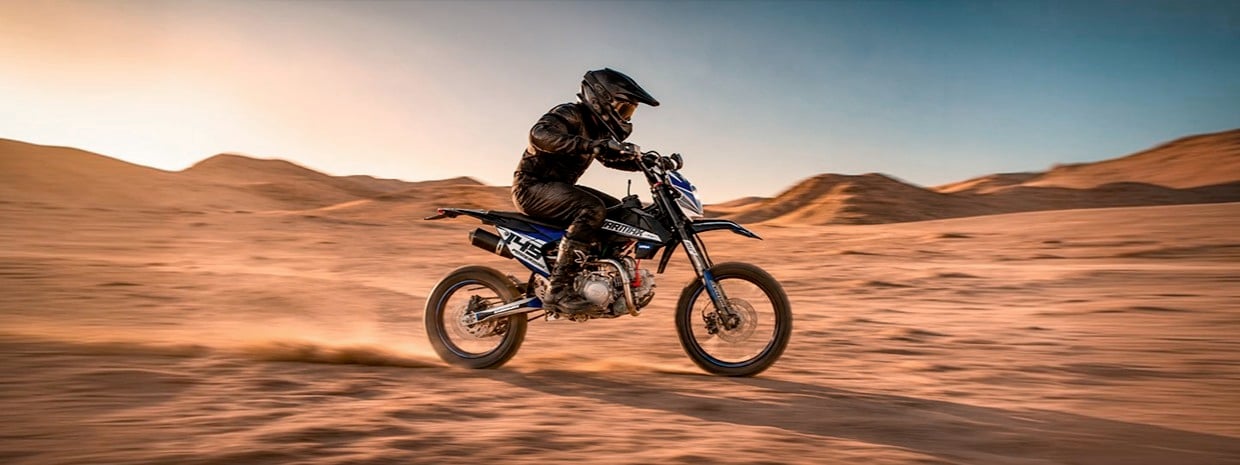
Power and price aren't everything when buying your first enduro. With dozens of off-road bikes around, it's easy to get caught up in engine size and forget the most important question: can you handle the bike confidently? Your height and weight help narrow down your options to a few suitable models, but leg length, experience, and how you actually sit on the bike will ultimately determine your choice. This guide explains how to choose the right size and what to compare in terms of seat height, suspension, and riding position.
Why start the comparison with the height of the enduro seat?
Among the power, weight, and suspension travel figures, seat height deserves a beginner's early attention. It directly affects your ability to prop the bike up when stopped and maneuver slowly. But it's not the only factor: seat width, bike mass, and leg length also influence how easily you reach the ground.
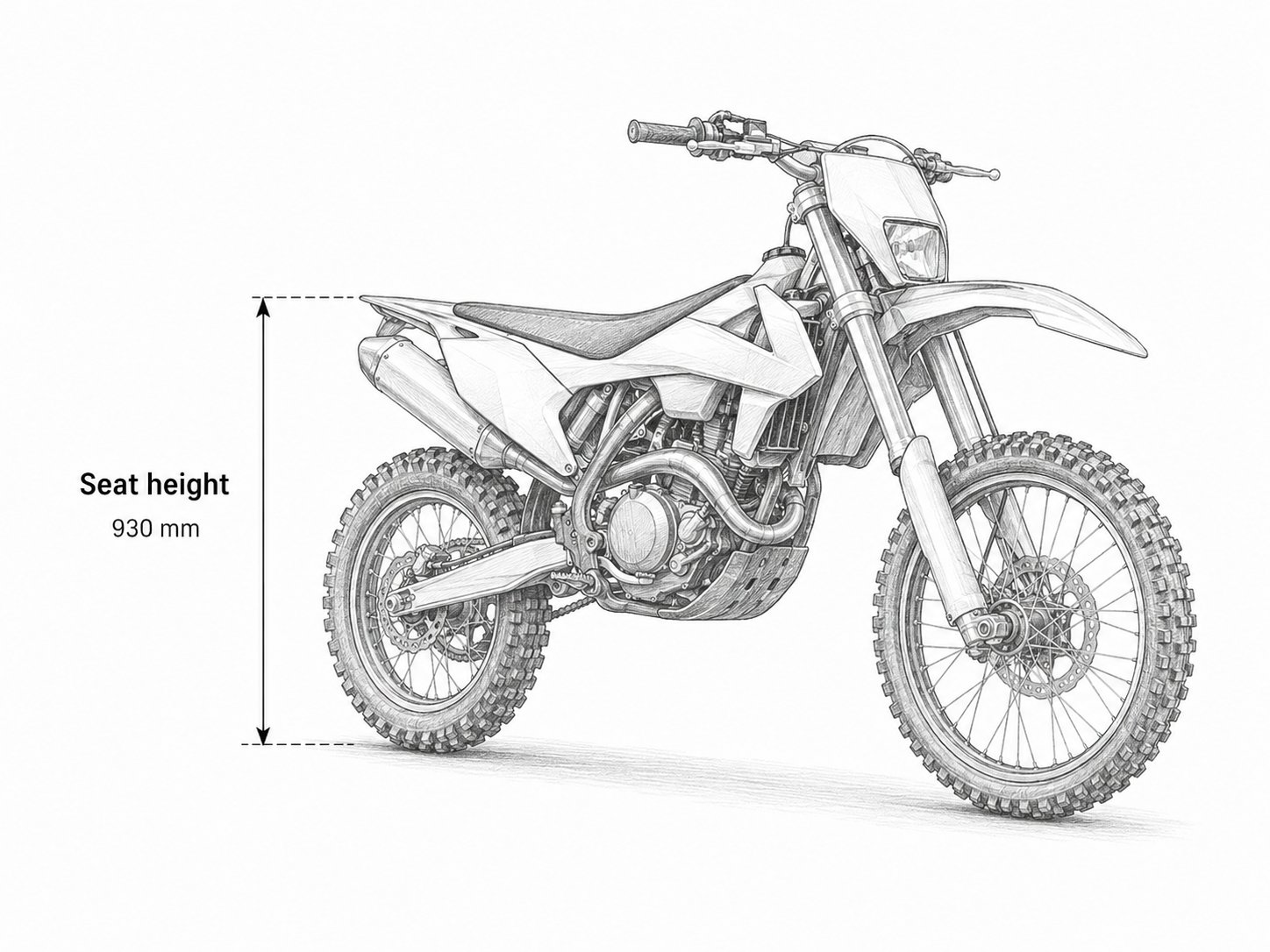
Seat height is the distance between its lowest point and the ground when the bike is standing upright without a load. The more confidently you can place your foot on the ground, the easier it is to stop. In enduro, where slow maneuvers, technical sections, and sudden stops are frequent, this isn't just a matter of comfort. A bike that's too high for you to handle will consume your attention on maintaining balance instead of reading the trail, and you could easily fall over in a simple situation.
How do seat heights differ between categories?
- Pit bikes and children's models: Options are available with heights of approximately 620–830 mm. Sizes, age limits, and load capacities vary from model to model; the seat's low profile alone does not guarantee its suitability for a child.
- Mid-range enduro: There are models around 890mm, which are among the options compared by enthusiasts and those moving from smaller bikes.
- Full-size enduro bikes: Some seats reach 930mm and more. These bikes require leg length, skill, and control appropriate to their height and weight.
Starting point: Support the bike confidently
The sitting test is more useful than a size chart alone. Sit on the bike and, with the help of the team, keep it upright. Can you place the balls of your feet on the ground without excessive strain or an uncontrollable tilt? This is a good initial indicator for a beginner. The entire soles of the feet don't always need to be on the ground; many riders use higher bikes, but they rely on proper stopping technique and experience.
If reaching the ground requires stretching out on one toe while struggling with the weight of the bike, don't ignore the warning. Start with an easier-to-control option, or evaluate the solution with a trainer before buying.
A confident stance changes the experience: the stress of stopping is reduced, and your energy is directed towards learning to ride and enjoying the trail, not trying to control a bike that's bigger than you can handle right now.
Enduro size guide by height
The following table helps you identify models worth comparing, but it's not a purchase recommendation or a safety standard. The figures are very approximate: two people of the same height may need different seats due to leg length, seat width, and suspension drop under load. If the suggested height seems too high, choose what you can actually control, not what the table dictates.
| Driver's height | Seat height for comparison | Potential category | What are you checking? |
|---|---|---|---|
| Approximately 140–150 cm | Options starting from 620 mm | Small pit bike | Ground access and handlebar positioning, age and load limits, and appropriate training |
| 150–160 cm | Approximately 780–840 mm | Larger pit bike or low-seat enduro | Foot stability and weight control; a seat below this range may suit you. |
| 160–170 cm | Approximately 840–890 mm | Low or medium enduro | Leg length, seat width, and your ability to support the bike when stopped |
| 170–180 cm | Approximately 890–930 mm | Medium or full-size enduro | Comparison to actual sitting; it is not necessary to start with the highest seat. |
| 180–190 cm | Approximately 930–960 mm | Full-size enduro | Knee space and standing position, with adjustable height selection. |
| 190 cm or more | Options around 960 mm or more | Full-size enduro with a suitable amount of space | The distance between the seat, armrests, and handlebar, not just the seat height. |
The final decision comes after trying the size on the bike itself. Body length is not equal to leg length, and a narrow seat might be easier to reach than a wider seat at the same height. Treat the chart as a starting point for research, then prioritize actual control over the numbers.
Two steps to choosing the right enduro for your height
Use the measurements to narrow down the options, then test the bike sitting and standing. Measurement saves you time, and experimentation reveals what isn't listed in the specifications.
Step one: Compare leg length to seat height
Instead of relying on a single formula for body length, start with these steps:
- Measure the length of the inner leg from the ground to the top of the thigh.
- Compare the measurement to the seat height and width in the nominated models.
- Consider the driving shoes and the suspension drop under your weight.
- Exclude what you cannot confidently attribute to the experiment.
For example, a height of 186 cm alone does not determine the appropriate seat height:
A seat with a height of 950 mm might be comfortable for a tall person and difficult for someone of the same height. A lower seat might be suitable for both. What determines the choice is support, control, and riding position, not a mathematical calculation.
The rider's weight compresses the suspension, so the feel of the bike differs from its height when unloaded. The drop is not a fixed increase or decrease in size; it is adjusted according to the model, rider weight, and riding equipment.
Step two: Test the size in the showroom
Visiting the showroom allows you to compare several models directly. Start by sitting and standing, then arrange a test drive if available for the model and under the appropriate conditions.
Try the bike with your gear, especially enduro or motocross shoes; they change the feel of the ground and the control. While seated, make sure you can support the bike without straining. With the help of your team, gently rock it from side to side to understand its weight distribution, without trying to save a long mile on your own.
Next, stand on the footrests while securing the bike. You should reach the handlebars without bending over, and grip the bike naturally with your knees. This standing position is just as important as sitting, as you'll be using it a lot on rough terrain.
Want to compare measurements practically? Contact the Sharmax showroom in New Cairo to arrange a visit and discuss the available test drives. The team will help you compare seat height, weight, and riding position: +20 10 4040 4039.
Enduro for short people: What to do if the seat is too high?
If the bike is slightly higher than your comfortable control level, there are potential solutions. But start by assessing the original size and adjusting the suspension correctly before modifying the bike's geometry.
- Lower seat height: A properly fitted seat or thoughtful foam adjustment may provide a difference of approximately 10–20 mm in some models. Pay attention to its effect on comfort and distance to the footrests.
- Lowering the suspension: Some bikes offer solutions that can lower the ride height by approximately 20–40 mm. This alters ground clearance, geometry, and potentially suspension travel; a compatible kit should be selected, installed, and the front and rear suspension adjusted by a professional, not by randomly adjusting the fork.
- Standing on one foot: This can be learned under the supervision of an instructor and in a suitable training facility. It is a useful skill, but not an immediate replacement for a motorcycle you can control.
Choose the least invasive solution that offers good control, and don't add multiple modifications before understanding their impact. Sometimes, a simpler model is the simplest and best choice.
Enduro for tall people: How to get enough room to move?
For tall riders, the opposite problem arises: high knees, a hunched back, and arms at an uncomfortable angle. This restricts their riding position, even if reaching the ground is easy. Adequate space between the seat, armrests, and handlebar is essential, not just the highest available seat.
The situation can be improved by choosing a suitable structure with these options:
- Higher handlebars or compatible lifting bases: A calculated adjustment helps to make the back and arms curve naturally angular. Ensure the wires and hoses are the correct length and are not overstretched when fully rotating the handlebars.
- Adjustable footrests: The knee angle can be opened and provide extra space, while also taking into account clearance, brake control, and transmission.
- A higher and flatter seat: This may provide greater freedom of movement and transition between sitting and standing, provided that it does not damage the support of the motorcycle when stopped.
From the outset, compare full-size motorcycles, including models with a seat height of 930 mm or more, rather than trying to convert a small frame into a large bike through modifications. Ultimately, however, your choice depends on leg length, experience, and control.
How does the rider's weight affect the choice of enduro?
The suspension works under your actual weight, including clothing, helmet, shoes, and bag. Some factory settings use a reference weight close to 75–80 kg, but this isn't standard for every bike. If your load exceeds the range the springs are designed for, the default settings won't necessarily be sufficient.
A rider with a light load might not compress the suspension as much as needed, resulting in a harsh, bounce-like feel over bumps. Conversely, a heavier load can cause the suspension to sag excessively or reach the end of its range upon impact. This affects grip and handling, so springs and damping settings should be chosen according to the model, not just weight.
These are initial guidelines for reviewing comments, not a recipe for adjustment:
- Under 65 kg: Softer springs may be needed if the drop measurement proves that the current springs are stiff for the load.
- 65–85 kg: The settings of some models may be a suitable starting point, with actual drop measurement and adjustment.
- 85–100 kg: A more suitable spring rate for the load may be required; increased preload does not always compensate for an unsuitable spring rate.
- 100 kg and above: Check the load limits, front and rear spring rates and damping settings with a specialist.
Therefore, simply sitting on the bike while it's stationary isn't enough to make a complete choice. Calculate the weight of your gear and adjust the suspension according to the model's manual before your first serious ride. This will give you a more accurate picture than choosing a bike based solely on engine size.
Choosing engine capacity based on weight and experience
Engine displacement affects engine performance, but it doesn't determine its character alone. Response, engine type, transmission ratios, and motorcycle weight are also important.
A heavier load requires torque appropriate for the terrain, especially uphill and in sand. But the most useful torque is the one you can use with control, not the highest number on the chart.
For beginners and light riders, models with quiet responsiveness in the 125–250 cc range are worth considering. The goal is a bike that helps you learn technique rather than spending the ride battling an engine beyond your experience. These engine capacities don't necessarily mean every racing bike is suitable for beginners.
When you weigh 90 kg or more and ride challenging trails, you might consider 250–450 cc options with load-bearing suspension. Don't upgrade to a 450 simply because of your weight: a more balanced 250 model might be more suitable, while a more powerful bike requires more experience. Choose based on your actual motor skills, training, and the nature of your ride.
Sharmax models for comparison by rider height
These are examples from the Pit Bike and Enduro range to create a short list, and are not a guarantee that a model will fit everyone within a specific height range. Height varies depending on the equipment and version, and trying on a bike is the crucial step.
Length 130–150 cm: Start with the smaller models
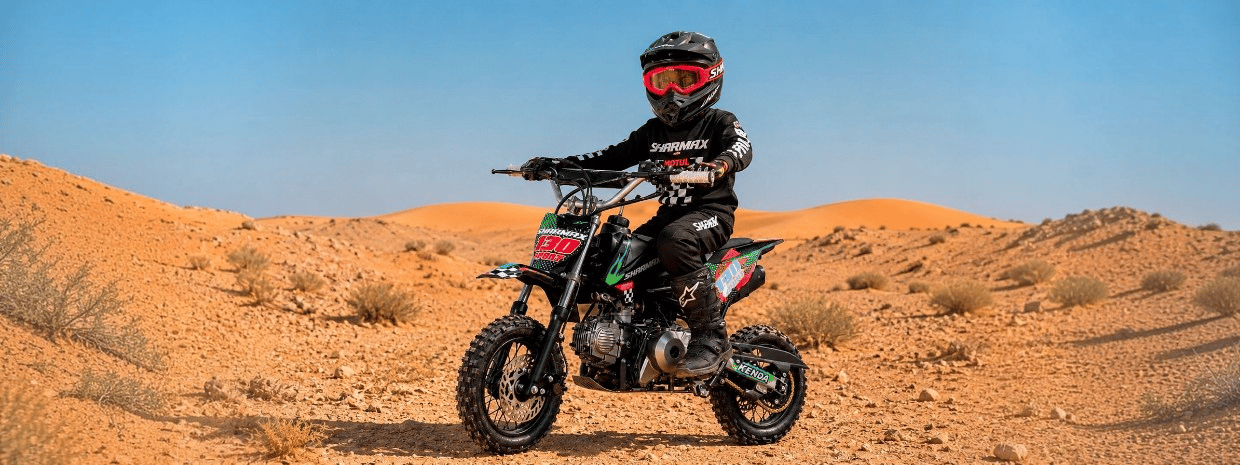
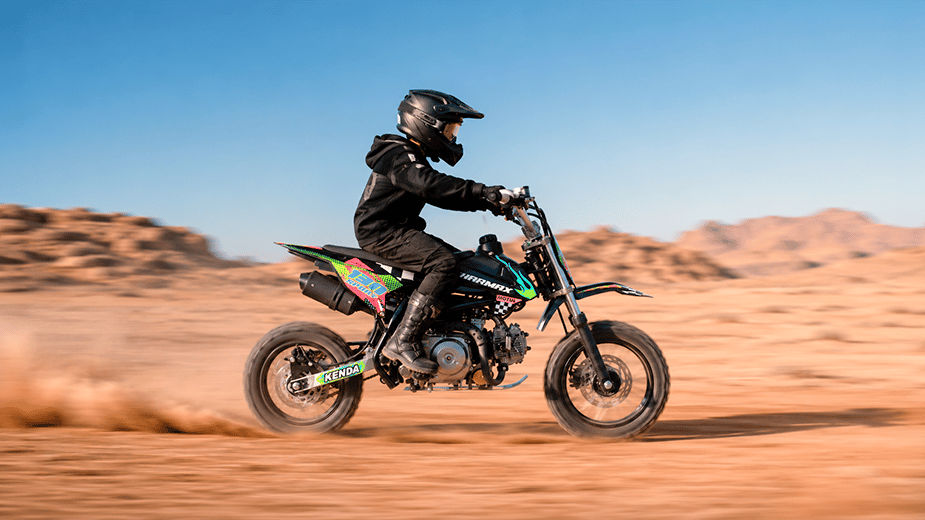
There are options with seats starting from around 620 mm, including the Sport 130 Mini in the smaller version. The bike must be compatible with leg length, age, load, and training level; simply touching the ground with your fingertips is not enough to confirm a suitable fit.
Length 150–160 cm: Compare the low seat and weight
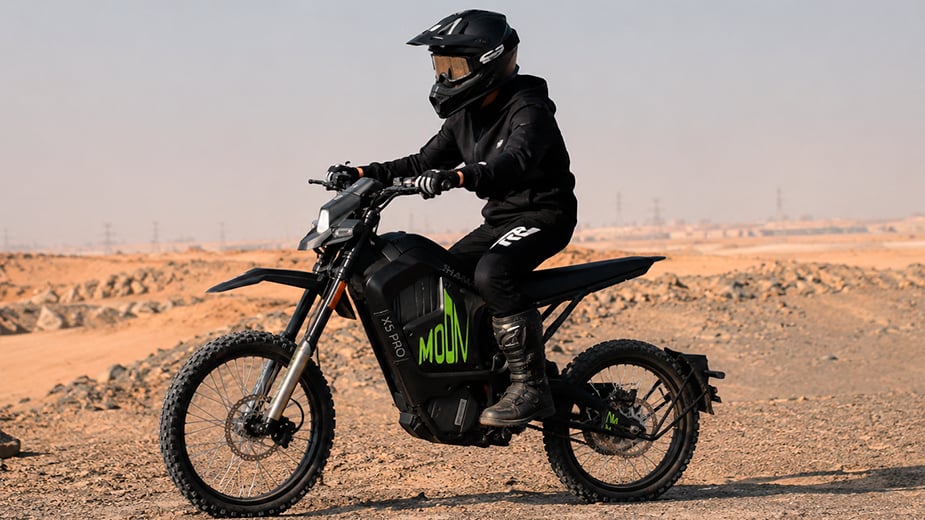
The X5 Pro E is an electric option to compare after checking the exact version’s seat height, weight and controls. Assess reach to the ground and torque response together. A suitable training environment and safe low-speed test are more useful than assuming that a seat-height range guarantees the right fit.
Length 165–175 cm: More than one direction to choose from
In the 830–890 mm seating range, compare larger pit bikes like the Power Max 145 and Power Max 190, depending on the version and wheel size. For those who prefer a larger frame and more experience, the Power Max 320 with a seat of approximately 890 mm is a good option. Choose what you can control in terms of weight, not just what has a higher number in the name.
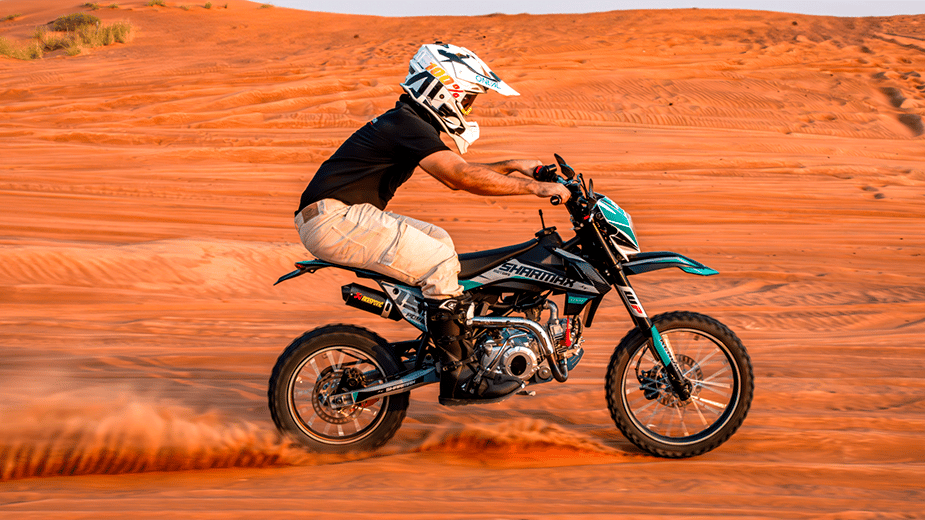
Height 175–180 cm and above: Full size is not a single option
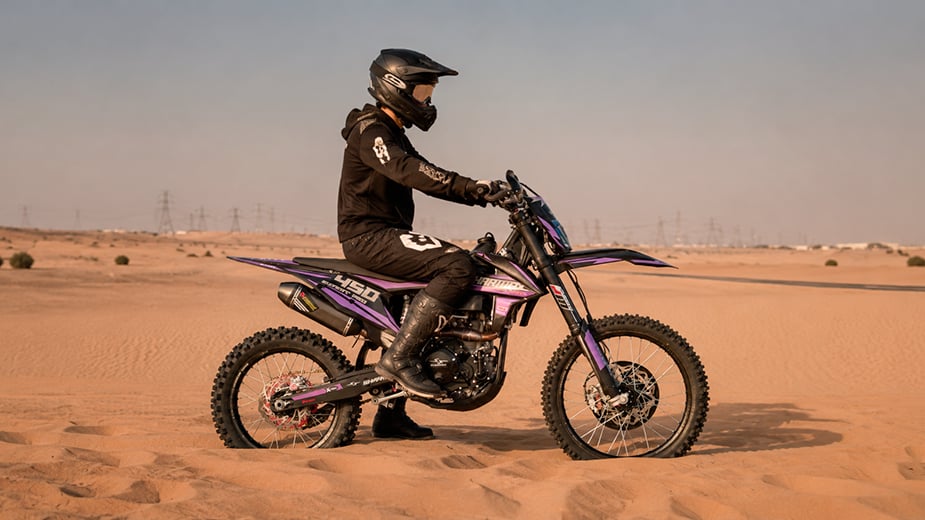
The Sport 280 versions, with a seat height of approximately 910 mm, are comparable to the Expert Pro 450, which measures around 960 mm. The latter is a higher-riding and more demanding option; rider height alone is not enough to guarantee suitability. Consider the overall driving space, engine response, and handling when stationary.
Frequently Asked Questions
What is the appropriate enduro size for a beginner?
Start with seat height, weight and how confidently you can support the bike at a stop, then assess engine response. Your first enduro should feel manageable at low speed.
Is the rider's weight important when choosing an enduro?
Yes. It affects suspension drop, comfort, and handling. Also, calculate the weight of your equipment, then match the load, springs, and settings to the model's manual.
Can the enduro be lowered if it is high?
Some models may benefit from a lower seat or a suitable suspension adjustment. Major changes affect ground clearance and geometry; have them done by a professional and compare them to a lower-riding bike option.
I am short and overweight; what should I choose?
Start with a seat and weight you can control, then choose a suspension and load limit appropriate for your weight and equipment. There's no rule that dictates an 890–930 mm seat or a massive motor; your leg length, experience, and motor characteristics will determine the practical choice. Compare models in the showroom before deciding.