Checking a Motorcycle Engine Before Buying
Learn what to observe when inspecting a used motorcycle engine, which warning signs matter and when a professional pre-purchase check is worthwhile.
30 Aug 2026

If you choose a used motorcycle instead of a new one, the condition of the engine deserves special attention; a clean appearance alone does not reveal what has been done inside or how it has been maintained.
Learning how to properly check the condition of a motorcycle engine before paying any money is the best insurance against buying someone else an expensive problem.
This guide provides initial steps you can take by looking, listening, and asking the right questions, and then outlines the specialist checks that are worth arranging with a technician before purchase.
Start by checking the motorcycle engine before starting it.
One of the most important things you can do is inspect your motorcycle while the engine is still cold. A warm engine can sometimes make it easier to start and may mask problems that become apparent after the motorcycle has been sitting for several hours.
What to check while the engine is cold
Look around you:
- Engine casings
- cylinder head
- Gaskets and seals
- Oil pipes and coolant hoses
- Radiator
- The area under the motorcycle
- Exhaust manifolds
- Chain and front sprocket area
Traces of fresh oil may indicate an active leak, while dried residue suggests the problem has been present for some time. Also, check for coolant stains, especially around hose connections, the radiator, and the water pump.
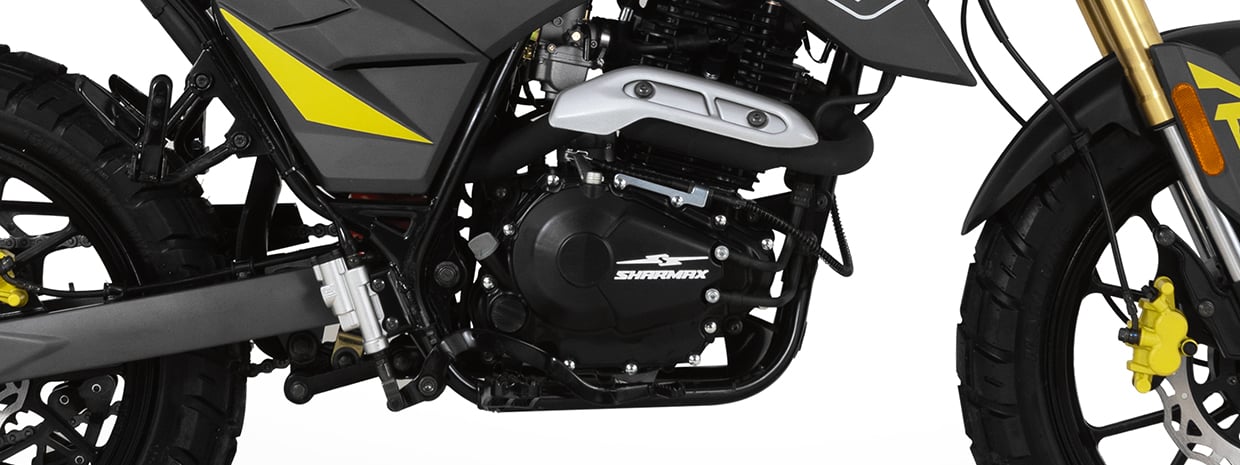
Motorcycle engine detail. Photo: Sharmax.
How to check a motorcycle engine during a cold start
Ask to see the bike start cold for the first time; it may have difficulty starting or make noises that aren't apparent after warming it up. If the engine is warm when you arrive, don't assume there's been tampering; instead, arrange a time to check it cold.
- Ask the seller not to start the bike before you get there.
- Check the engine temperature safely, and do not touch the exhaust or engine parts as they may be hot.
- Listen carefully during the first 10-15 seconds after turning it on, looking for any knocking, rattling, or heavy smoke.
Cold Start Warning Signs
Be careful if the motorcycle is:
- It takes repeated attempts to get started
- Needs an unusually large throttle opening to start
- It makes a loud mechanical noise immediately upon startup.
- Frequently stalls
- The engine operates erratically at idle.
- It emits thick smoke
- Takes unusually long to settle to a steady idle
A bike that struggles to start when cold, requires several attempts, or has its engine RPMs immediately increased just to keep working, is already telling you something worth investigating further.
Listen for suspicious sounds
Listening can help identify what needs checking, but it doesn't diagnose the problem on its own. The noise might be coming from the engine, the drive chain, or a loose part. Compare the sound to what's typical for your model, and consult a mechanic if it's unusual or new.
| What you hear | Possible source |
|---|---|
| Tapping or rhythmic tapping in idle mode | This may be related to valve clearance; some sounds are normal depending on the model. |
| A deep knocking sound that worsens under the load | This may indicate internal wear and requires professional examination. |
| A sharp whirring sound that changes with speed | It may be related to the engine or transmission; source identification is required. |
| A metallic rattling sound that changes with the position of the throttle. | A loose heat shield or exhaust manifold, not necessarily the engine. |
Listen with the transmission in neutral, in a safe outdoor location. Do not use the engine to spin a raised rear wheel to investigate noises, or place the engine under heavy load to provoke a fault. Let a qualified technician isolate engine or transmission noises.
Check the gauges and warning lights
Check the warning lights when starting the engine, then observe whether they turn off as described in the motorcycle's manual. Overheating or a persistent oil pressure warning light while the engine is running should not be ignored. This could be related to cooling, lubrication, or sensors, and requires diagnosis.
- Monitor the temperature and do not continue operating if it reaches the warning range; follow the engine shutdown instructions in the manual.
- If the oil pressure warning light remains illuminated while the engine is running or appears suddenly, stop the engine safely and request a check.
- On air-cooled motorcycles, check the cooling fins for dust and debris buildup, which can obstruct airflow.
Check the spark plugs whenever possible.
The condition of the spark plugs can aid diagnosis, but accessing and removing them isn't always easy. Have a technician inspect them with the seller's permission and the appropriate tools; it's not worth damaging the threads or reinstalling the spark plug with incorrect torque.
| Spark plug condition | A possible indication, not a definitive diagnosis. |
|---|---|
| wet black oily deposits | This may indicate oil ingress; review with other tests. |
| red or brown deposits | Fuel additives can affect deposit colour; this alone does not establish a lean mixture. |
| clean light brown color | It may look normal, but it does not guarantee engine safety. |
| Cracked insulation or signs of electrical arc | Damage requiring replacement and investigation of the cause if needed |
Check the condition of the oil and ask about its consumption rate.
Ask about the type of oil, the date of the oil change, and the amount of topping up between services. A dark color alone isn't enough to diagnose the problem, but a sudden increase in oil consumption, a leak, or a distinct burning smell warrants investigation. Possible causes include external leaks or internal wear; these cannot be determined visually alone.
- When was the oil last changed, and at what grade?
- Has the seller noticed that the bike has been consuming more oil lately?
- Are there any visible oil residues around the engine base or exhaust pipe?
If no clear answers or records are available, treat the maintenance history as undocumented and request an independent audit before making a decision.
How to test the condition of a motorcycle engine using a compression test
A cylinder compression test provides useful information about engine sealing, but it's only part of the diagnostic process and not a complete guarantee of engine health. It's best to have it performed by a technician familiar with the model's specifications.
- For a compression test, a technician fits the appropriate gauge to the spark-plug hole and cranks the engine with the starter, following the service procedure with fuel and ignition safely disabled. Results are compared with the manufacturer's limits and permitted variation between cylinders. Low readings can have several causes, including valve or piston-ring wear and the test method.
- A cylinder leak test uses compressed air to measure tightness and help pinpoint the leak path. It requires proper piston positioning, tools, and expertise; the engine may be moving under pressure, so it should be left to a technician.
Follow the service manual's procedure and temperature requirements. Battery condition, the decompression mechanism and the test method can affect the reading, so a generic figure from the internet is not a reliable benchmark.
Check the color of the exhaust smoke
The exhaust can provide useful indicators about the condition of a motorcycle engine. The color of the smoke during operation and acceleration is a quick visual check that costs nothing and takes only a few seconds.
- Blue or bluish smoke: Oil may be leaking into the combustion chamber. Possible causes include worn piston rings, cylinder wear, or problems with the sealing valves.
- Dark or black smoke: The engine may be running on a very rich fuel mixture, or there may be a problem with the fuel injection system, air filter, or sensor.
- White smoke after heating: This may indicate that coolant is entering the combustion chamber of a liquid-cooled engine, although some engines naturally produce a light vapor under certain conditions.
- Thick smoke when accelerating: This may indicate internal wear that becomes more noticeable when the engine is under load.
Try it in real life
Everything examined so far is done while the motorcycle is stationary or idling. During a test drive, engine problems that only become apparent under load are revealed. This step is essential in any serious motorcycle engine inspection.
- If the bike's condition, your experience, your license, and the seller's approval allow, test it in a suitable place and with protective gear. Start with gradual acceleration and observe the response, without testing its top speed.
- Leave the bike idle for a minute and make sure the engine speed is constant, not fluctuating or stopped.
- Open the throttle gently and listen for unusual noises or hesitation.
- After moderate driving, ensure the engine returns to a normal and stable idle speed.
During your test drive, check the following:
- Smooth start from stop position
- Constant acceleration
- Regular response within a safe driving range
- excessive vibration
- Disruption or loss of response under load
- High temperature in traffic
- Warning lights
- Unusual noises from the engine or transmission
After stopping, inspect the engine again. Pressure and temperature readings may reveal oil or coolant leaks that weren't apparent when the motorcycle was cold.
Check the service history
Records don't replace a physical inspection, but they do provide useful context. A motorcycle that has undergone documented regular maintenance, yet still exhibits one of the warning signs mentioned above, warrants a closer examination. This indicates that the problem has developed despite proper care, posing a different risk than a neglected motorcycle.
Before buying, ask the seller:
- Is there a complete maintenance log?
- When was the last time the oil and filter were changed?
- Has the motorcycle ever overheated?
- Has the engine been rebuilt or modified?
- Are there any warning lights or known faults?
- Can I arrange for an independent examination?
The type of oil is also important. Make sure the owner is using oil that meets the manufacturer's specifications, rather than judging the engine solely by the color of the oil currently in it.
Complete Motorcycle Engine Checklist
| step | What should be checked? | red mark |
|---|---|---|
| Cold Start | It starts up smoothly within a few seconds | Multiple attempts; a high idle state is required to remain operational. |
| voice | Even and consistent sound at idle and under load | Knocking, tapping, whining sounds that change with the engine's rotational speed. |
| Measurements | The oil pressure indicator light turned off, and the temperature stabilized. | The warning light remains on, and the temperature rises unchecked. |
| Spark plugs | Case and electrodes compatible with usage and specifications | Black oily, damp, or cracked sealant |
| oil | Correct level and specifications, and a clear consumption record. | A sudden increase in consumption, rough texture |
| pressure | It matches factory specifications, even between cylinders. | Generally low or uneven between cylinders |
| Exhaust smoke | Clear or very light fog at startup | Thick blue, white, or black smoke |
| Track test | Smooth acceleration and stable idle rotation after driving | Frequency, malfunctions, irregular return to idle mode |
| Service log | Fixed and documented time periods | Gaps, inconsistent mileage records |
Why is a new bike from the official dealer still the best option?
All of the above exists because used motorcycles contain unknown elements, and no examination, however thorough, can remove them all.
When purchasing a new Sharmax motorcycle, review the model specifications, delivery documents, and available service options in Egypt. Ask for the written warranty terms specific to your market and model; warranties from other countries do not automatically transfer.
To compare the riding position and bike responsiveness, contact the Sharmax Egypt team regarding the possibility of arranging a test ride and its terms. The availability of this service in another market does not automatically guarantee its availability for every model in Egypt.
A new bike gives you a clearer starting point in terms of usage history, but the best decision is still based on your needs, budget, bike specifications, and after-sales service.
Frequently Asked Questions
Do I need special tools to inspect a motorcycle engine before buying it?
For a preliminary inspection, visual inspection, listening, and reviewing logs are sufficient. However, compression testing or spark plug removal require tools and expertise; arrange for these to be done by a technician instead of buying a gauge and attempting to diagnose the engine yourself.
How long should the proper examination process take?
Allow sufficient time for cold starts, inspections, and record checks; the initial inspection may take 30–45 minutes or more. Specialized tests require separate time depending on the model and what is revealed during the inspection.
Is a low mileage sufficient proof that the engine is healthy?
No. Heat and dust can damage the engine much faster than mileage alone suggests, which is precisely why a practical inspection of the motorcycle engine is more important here than reading the odometer itself.
What is the most reliable test if I only have time for one test?
Arrange for an independent inspection by a qualified technician. No single test reveals everything; the technician will choose to measure pressure, check for leaks, or perform a fault inspection based on the symptoms and the condition of the bike.
Should I buy a motorcycle with a minor warning light on the engine if everything else is fine?
Don't assume a problem is "minor" before it's diagnosed. Request a report and repair estimate, especially if you see warning signs like oil pressure issues, persistent smoke, or loss of pressure. A price reduction doesn't compensate for buying a motorcycle without knowing its safety.