The Difference Between ATVs and UTVs in Egypt
Compare ATVs and UTVs in Egypt: seating, handling, passenger capacity, cargo and ownership costs. Choose the off-road vehicle that fits your needs.
04 Sep 2026
ATV & UTV – three-letter words with one letter difference. They both denote something off-road on four wheels, and that is largely where similarity ends. The two machine types serve different purposes and are structurally built in different ways. This article will help you understand why the Sharmax Force 1100 ATV, for example, is not the same as the Sharmax Race 580 UTV, even though they are both positioned as capable all-terrain vehicles. Learn more about how to distinguish utvs from atvs and how to pick the right four-wheeler.
Why ATVs are “bikes on four wheels” and why UTVs are off-road carts
Both machines have the all-terrain component in them. The all-terrain vehicle (ATV) and the utility task vehicle (UTV) might sound like they do the same thing, and to some extent, they do. Yet, there are nuances.
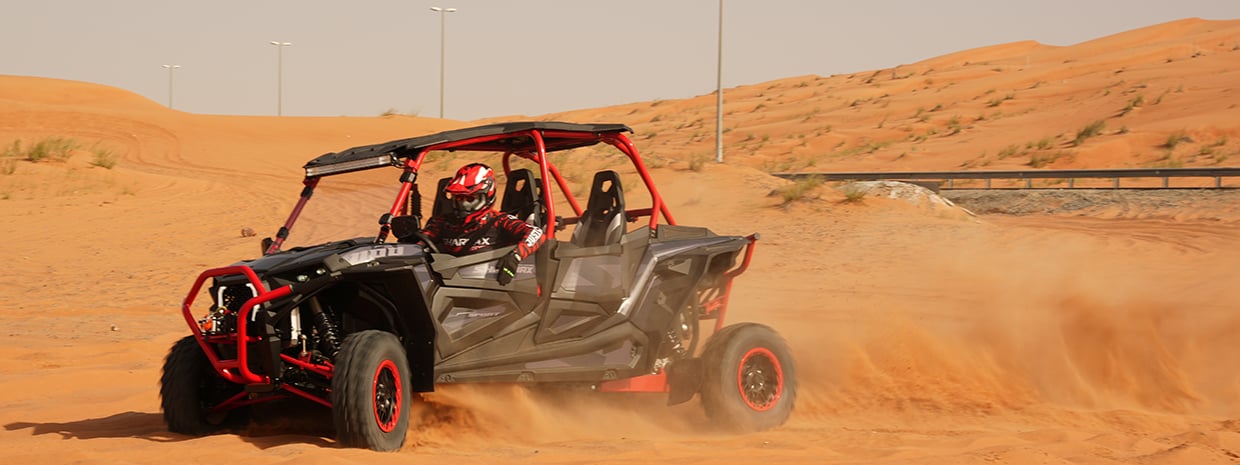
➡️To understand what is a UTV vs ATV, think of a UTV as a small car with no walls. Side-by-side seats, a steering wheel, and pedal controls are the features that make its layout resemble a car even more. A reinforced frame with front and rear bumpers and higher ground clearance give it the distinct wild, off-road nature. Also,“buggy” is another very common name for this category. There might be some confusion, though, since not every utility side-by-side can be called a buggy.
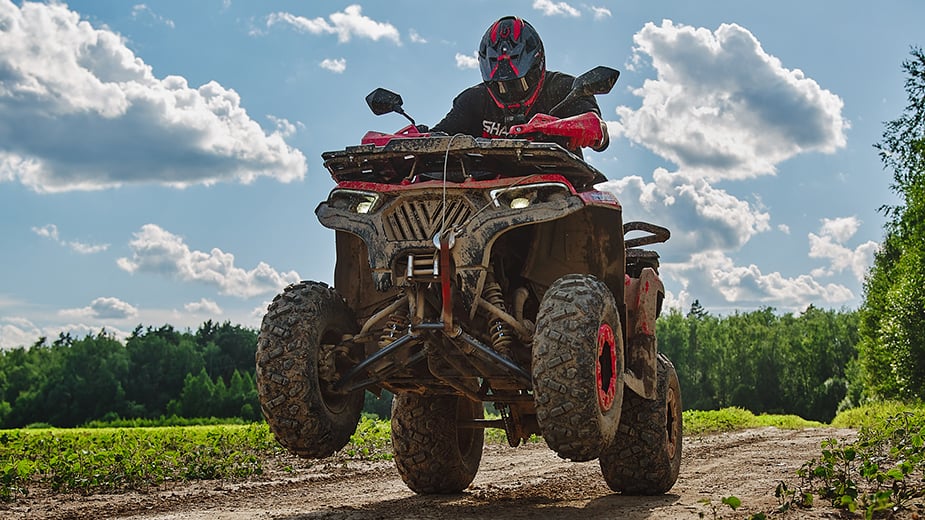
➡️An ATV is built more like a motorcycle on four wheels. The rider puts their legs on both sides of the vehicle and controls it with handlebars, and often uses a foot lever for gear shifting, depending on the model.
These design differences reflect different development paths. Buggies are associated with recreational and racing vehicles, while utility side-by-sides developed around moving people and equipment off-road. Today the family includes both sporting and working models, rather than one shared purpose.
Quad bikes developed from three-wheeled off-road motorcycles such as the Honda ATC models of the 1970s, which were originally created for recreation and sport. Only later were they adapted for utility work.
That history still shapes the difference between ATV and UTV today: UTVs lean toward carrying, comfort, and stability, while ATVs stay closer to active, motorcycle-style control.
ATV vs UTV difference: Sit astride or sit inside
So what is the major difference between an atv and a utv? All riddles aside, it is clearly visible in their exterior at the first glance, and you can hardly confuse them. The seating position of a rider tells it all.
➡️ On an ATV, the rider sits astride the seat with one leg on each side, like on a motorcycle. No surprise, the second most commonly used name for an atv is a “quad bike.”
➡️ On a UTV, the rider has a car-like position with a passenger seat placed to their right, which explains the “side-by-side” naming.
That design part is the main difference between an atv and a utv, that you can confidently use as your compass.
Steering feel: The real UTV vs ATV moment
Another difference you see straight away is how you handle an atv and a utv.
➡️A buggy borrows its logic from a car. You steer with a wheel, work the gas and brake with pedals, and (on manual versions) use a gear lever. If you have driven a car before, your brain relaxes because it already knows the pattern. The only surprise is that many buggies still come without power steering, so tight turns can feel like a mini gym session.
➡️An ATV feels closer to a motorcycle and involves more active body control. The throttle is commonly operated by a thumb lever on the handlebar, while the arrangement of brake levers and foot pedals varies by model. Some manual versions use a foot-operated gear selector. Learn the controls on your own machine before riding; do not assume every ATV has the same layout.
The difference is not only the controls but the rider’s body. In a UTV, stay seated with the belt fastened and keep your limbs inside the vehicle. On an ATV, you actively move with the machine and shift your weight for turns and obstacles using the techniques learned in training. That involved feeling is part of the appeal of ATVs, and a reason to practise before moving onto difficult trails.
ATVs vs UTVs: When a quad outruns a buggy (and vice versa)
If you think four wheels automatically mean better off-road performance, that is a common mistake. Everything depends on the terrain. The difference between atv and utv becomes most obvious when you match the vehicle to the terrain.
Adult UTVs are often wider and heavier than comparable ATVs. Some classes are around 600 kg or more and exceed 1.5 metres in width, versus examples of ATVs weighing 300–400 kg. These are rough comparisons, not rules for every model. On narrow trails, an ATV’s dimensions can be useful: some models, such as the Polaris Sportsman 570, can pass where a larger buggy will not fit.
Ground clearance matters too. Some buggies offer roughly 300–400 mm, versus 200–250 mm on some ATVs, with many exceptions. More clearance helps over obstacles but does not guarantee greater stability on slopes. Compare width, suspension, centre of gravity and approved operating limits as well.
Tyres are another important difference between individual models. Mud-clearing tread depends on the tyre design, and suitable tyre options exist for both ATVs and UTVs. Match the tread, size and load rating to the vehicle and terrain, using the manufacturer’s specified pressures. The setup matters as much as the category.
Speed and punch: Where UTVs leave ATVs behind
➡️Sport ATVs and UTVs can both offer strong performance, but neither category is automatically faster. Compare the manufacturer’s figures for the exact models, together with their mass, transmission and intended terrain. A claimed maximum speed describes a model’s performance limit, not a suitable speed for an off-road route.
➡️ATV top speeds vary substantially by class, and some powerful models are advertised around 100–130 km/h. A maximum-speed figure is not an appropriate speed for every trail. ATVs have no protective cabin, and UTVs are not immune to rollovers: terrain, visibility, rider experience and the manufacturer’s limits must guide speed in either vehicle.
Buggies need space to make use of their performance. On a narrow trail, visibility, stopping distance and vehicle width matter more than a top-speed figure. An ATV may be easier to manoeuvre because of its dimensions, but that does not justify accelerating along a blind trail or mean its brakes are automatically better than a UTV’s.
✅ The takeaway: a sport buggy shines in terrain suited to it, while an ATV benefits from agility on tighter trails. Choose for the route and the task rather than an imaginary race between the categories.
Passengers and cargo: Why UTV wins over ATV on pure practicality
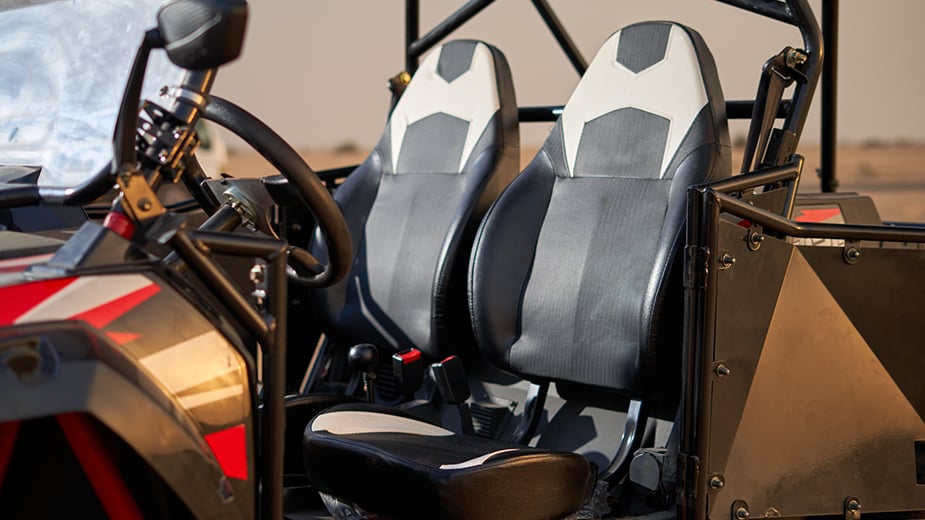
➡️For passengers and equipment, many UTVs offer a clear practical advantage. Layouts may have two, four or six seats; the Sharmax XForce 1100 Sport X4, for example, seats four. Utility versions offer different cargo and towing capacities. Figures such as 300–1000 L of storage or 1–1.5 tonnes of towing apply to particular classes and equipment, not every buggy or the named model. Use the approved limits of the actual vehicle and hitch.
➡️Most ATVs are designed for one rider, while some are specifically approved for two-up use. Certain models have total payloads around 200–300 kg, including the rider, permitted passenger and cargo. Utility machines such as the Sharmax Force 650 EFI and Force 450 Cyber focus more on hauling and work than sport quads, but their individual limits still need to be compared.
Cost of ownership: What’s cheaper to buy and maintain?
In utvs and atvs, the pattern is simple: a buggy (UTV) usually costs more to buy and more to run. It is heavier, it burns more fuel, and it wears consumables faster. That’s the real atv vs utv difference once the “new toy” feeling wears off.
The following is a calculation example for 2,000 km per year using the stated consumption assumptions, not a promised fuel consumption for every ATV or UTV:
Key takeaway: if you’re browsing atv and utv for sale and want the cheaper long-term option, an ATV is usually the safer bet. A UTV makes sense when you actually use its extra seats, cargo bed, and towing ability often enough to justify the higher running costs.
Final takeaway: ATV or UTV? Which one is better and for who?
If you want the shortest honest answer to what is the difference between an atv and a utv, it’s this: an ATV is built for tight trails and rider control, while a UTV is built for passengers, cargo, and “small off-road truck” practicality.
The tricky part is that sports and utility versions inside both categories behave like completely different machines, so always compare the right “type to type,” not just ATV vs UTV.
Choose an ATV if you want…
- Tight trail access: narrow forest paths, technical lines, places where width matters.
- Quick agility: turning around almost on the spot, weaving through trees.
- Lower ownership cost: fuel and consumables usually cost less than a buggy.
- Rider-first feel: you actively balance and “ride” the machine.
Best for tasks: solo exploring, reaching permitted fishing or hunting locations through narrow tracks, and short technical off-road trips with light-to-medium gear within the approved payload.
Important note: A sport ATV is for speed and fun, not hauling. A utility ATV is the one you want for hunting/fishing gear and real work.
Choose a UTV if you want…
- Passengers: real seats for 2–4 people with more comfort.
- Cargo space: proper storage bed/compartment instead of stacking everything on racks.
- Towing and work use: trailers, equipment, heavier loads.
- A cabin layout, seats and equipment suited to longer trips on terrain appropriate for the model.
Best for tasks: carrying people + gear, long outdoor days with supplies, towing, mixed terrain where comfort and capacity matter more than squeezing through tight trails.
Important note: A sport UTV is about speed and suspension travel. A utility UTV is about cargo, towing, and practical outdoor work. Same shape, totally different mission.
FAQ
What is a UTV vs ATV?
A UTV is a side-by-side with a steering wheel, pedals, seats, and a safety cage, built for a driver + one or more passengers. An ATV is a straddle-seat quad with handlebars and a motorcycle-like ergonomics, usually for a rider and one passenger at most.
ATV vs UTV: Which is better for hunting?
An ATV can be useful on narrow access trails because of its smaller width and agility. A UTV is more practical when carrying more people and equipment. The better choice depends on the model, route and load, with access and hunting permits respected in Egypt.
What should I choose for fishing trips?
For tight trails and quick access to remote water spots, an ATV is often the better pick. If you need to bring more people, bigger coolers, and a lot of equipment, a UTV makes the trip easier because of its seating and cargo space.
Which is safer for beginners: ATV or UTV?
A UTV provides a protective structure and seat belts, but these do not prevent every injury or make it automatically safe for a beginner. Choose a model suited to your experience, take training and use a helmet and the UTV’s restraints. An ATV also requires learning active body control, even with an automatic transmission.
Which is cheaper to own: ATV or UTV?
An ATV is usually cheaper to buy and maintain because it is lighter and uses less fuel and smaller tires. A UTV typically costs more to run, but it can replace a small off-road “truck” if you regularly carry people and gear.
Compare current Egyptian models in the ATV quad bike catalogue and the buggy and UTV catalogue. Confirm seating capacity, permitted use and equipment for the exact model before choosing.