ATV Safety Tips Every Rider in Egypt Should Know
Prepare for ATV riding in Egypt with guidance on protective gear, controls, braking and terrain. Learn practical ways to reduce risk and enjoy off-road riding.
04 Sep 2026
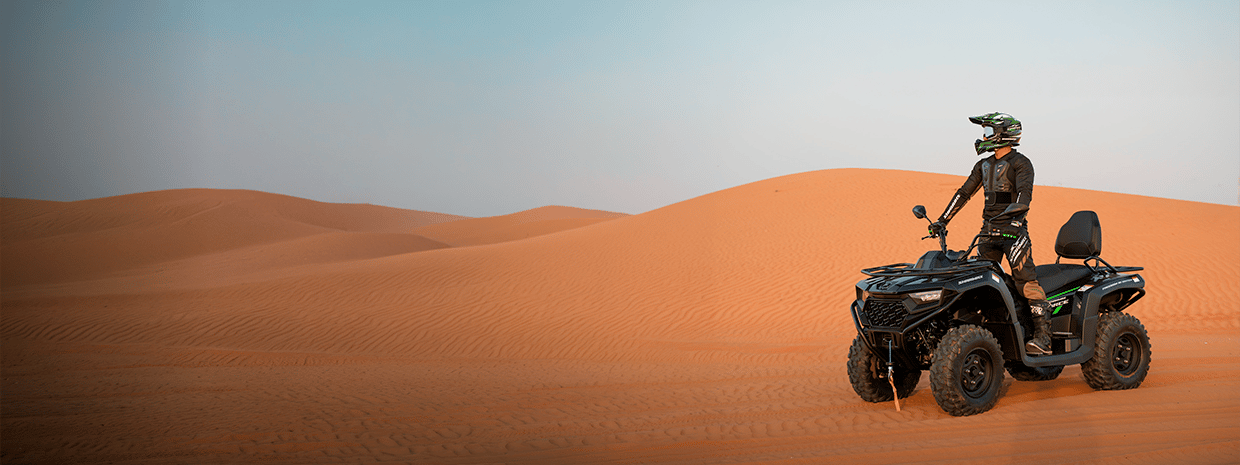
Is your new ATV standing idle while you build up the courage to ride it? Questions about control and rollovers are natural. Four wheels do not remove the risk of losing balance. This guide explains fundamentals that, together with hands-on training and your model’s manual, can help you understand the machine and reduce risk before heading out with more confidence.
A non-negotiable rule: never ride an ATV without gear
Ideally, when you look for an atv for sale, you should simultaneously look for an appropriate atv protective gear set. Unlike in a car with its closed cabin, when you are riding a quad bike, nothing protects you from outer impacts. Even a small tree branch can leave a deep cut if you hit it at 60 km/h. Basic safety gear and special rider’s armour are meant to protect you from such injuries and more serious risks.
Any ATV safety checklist must include:
- protective helmet
- protective goggles or suitable helmet eye and face protection
- gloves
- long-sleeve clothing or special riding gear with built-in protection
- motorcycle boots / riding boots
Look for protective gear in the off-road and enduro equipment section. Choose an approved motorcycle helmet in the correct size and fasten its strap properly. Motocross, enduro and dual-sport helmets may suit different uses, with goggles or suitable eye protection; a dust mask alone does not protect your eyes.
Why an ATV can roll over
Turning too fast or using an unsuitable technique can lift the inside wheels and lead to a rollover. Speed, weight distribution and ground conditions affect stability in a corner, so do not rely on four wheels alone to keep the ATV balanced.
Key stability factors include:
- suspension stiffness
- correct weight distribution
- cornering technique
- riding speed
Suspension settings affect how the ATV responds under load. Set preload and any permitted adjustments according to the model’s manual and payload, rather than simply making the suspension stiffer to try to prevent rollovers. Maintenance, tyres, speed and riding technique matter too.
For example, models like the Sharmax Hummer 320 RX LTD are designed for controlled off-road riding, with a compact ATV format and enough ground clearance for uneven terrain.
But even with a well-built quad, the rider’s technique still matters most.
Riding position and basic ATV safety tips
Be careful when turning
In contrast to their strong fun appeal, quad bikes are not meant for sharp cornering or aggressive turns at speed. The reason lies in their design: their center of gravity is higher than that of a passenger car, for example. Besides, their wheelbase is quite short and narrow compared to other vehicles.
If the rider enters a turn too sharply, the ATV can lift onto its side wheels and roll over, which may lead to serious injuries. So, you always need to be extra cautious when turning. The basic ATV riding rule is to slow down every time you change direction.
Shift your body in the right manner
Cornering requires appropriate body movement with the ATV rather than letting your body fall to the outside of the turn. Learn weight distribution with an instructor, starting with wide, low-speed turns on level ground. Modern suspension does not prevent rollovers, and a difficult trail is not the place to learn a new manoeuvre for the first time.
Learn your model’s braking controls
Know the brake levers, foot pedal and braking system on your own ATV, then practise progressive stops in a safe, level area. No single number of fingers suits every brake system and rider. The aim is a secure grip and smooth, controlled braking following the model’s instructions and your training.
Brake-force distribution varies by model, and some use a linked system. Avoid abrupt throttle inputs rather than relying on braking to recover from an unstable riding position. Learn how to combine throttle control and braking before tackling more demanding terrain.
Use the right technique on climbs and descents
A slope is not a simple extension of level-ground riding: traction changes and the vehicle can overturn. Follow the model and route limits; an angle or body position from a general article is not permission to attempt a hill.
Learn to assess the incline, surface and retreat plan with a qualified instructor on your vehicle. If the far side of a crest is hidden or you do not know the approved response to an interrupted climb, choose another route. Do not discover a recovery technique while already on the slope.
Body positioning and brake use on climbs and descents are practical skills requiring training and the exact model manual. This section explains the risk and preparation; it does not replace a riding lesson.
Adjust to different surfaces
ATV riding rules have their nuances when the surface changes under your wheels.
Sand and dirt
A 200cc ATV can handle sand and dirt quite well, although sand is not as easy on a quad bike as it is on an enduro motorcycle. The ATV has wider wheels and a larger contact patch, but it is also heavier and reacts differently to soft ground.
The main rule is to use your body weight correctly. Keep the throttle smooth, avoid sudden braking, and do not fight the handlebars too hard. If the front wheels start digging into sand, shift your weight slightly back and keep the ATV moving steadily.
Mud
Mud is tricky because traction changes every few meters. Avoid sudden throttle moves, because spinning wheels dig deeper instead of moving you forward.
For muddy sections, enter slowly, keep a steady line, and do not stop in the deepest part if you can avoid it. If the ATV starts slipping, reduce speed and let the tires find grip again. After riding through mud, check the brakes, radiator area, chain, and suspension parts, because wet dirt sticks everywhere.
Water
Before any permitted water crossing, assess the depth, bottom, current and model limits. Avoid flowing water or a crossing you cannot evaluate, and do not enter at speed. A trail running through water does not mean the crossing is suitable for your ATV.
The model’s manual determines permitted wading depth and conditions, not footrest height or drivetrain alone. Even machines equipped for tougher conditions, such as the Sharmax Spyder 1100, must stay within their approved limits: a snorkel does not make deep water or currents safe. Afterwards, follow the specified brake-drying, inspection and maintenance procedure.
More ATV riding safety tips: use common sense
- Start with easy, permitted routes that you know and build difficulty gradually. Do not assume a trail suitable for an enduro bike is wide enough or appropriate for an ATV; width, obstacles and gradients need separate assessment.
- Never operate an ATV under the influence of alcohol or substances that impair attention. Even a small amount can affect judgment and reaction time, putting you and people around you at risk.
- Avoid riding alone. It’s better to have a companion who can help you out if something goes wrong.
- When the route is unfamiliar, try to keep speed down and avoid sharp moves. Check the route before the ride, study the terrain, and choose slopes that match your skill level.
- Be careful on slippery roads, as you may lose control easily.
- Learn how to handle stalling on a slope or losing traction during practical training, before encountering those situations. Do not treat jumping off as a universal solution; the correct response and dismount depend on the vehicle’s position, slope and model-specific instructions.
- Protective equipment reduces some risks but does not make a fall safe. Keep a margin for error and stop before reaching a situation you cannot control, rather than relying on a helmet and armour alone.
Final take: safe riding can also be fun
Ideally, it would be great if you could take a few riding lessons with an instructor before riding on your own. Master the skill of shifting your body weight and refrain from speeding, at least while you are still new to the task.
We hope our ATV safety tips were useful and also inspiring enough for you to take the quad out of the garage and head for new adventures safely. Remember – controlled fun is still fun but with less risk and more good memories.
FAQ
1. Is ATV riding safe for beginners?
ATV riding can be safe for beginners when the rider follows basic rules: wear proper gear, start slowly, avoid steep slopes, and practice on open flat terrain first.
2. What gear do I need for ATV riding?
You need an approved, properly fastened helmet, eye protection, gloves, long sleeves and trousers, and boots covering the ankle. Body armour and knee protection can be added for the riding involved. A dust mask is not a substitute for goggles or suitable helmet eye protection.
3. Why do ATVs roll over?
ATVs, with their high center of gravity, usually roll over on sharp turns. Incorrect body position and lack of basic riding skills and braking amps up the risk.
4. Can I ride an ATV through water?
A shallow crossing may be permitted for certain models within the manual’s depth and operating limits. Avoid flowing water or unknown depths, and follow the brake and vehicle inspection procedure afterwards.
5. What is the most important ATV safety tip?
The most important ATV safety tip: never ride faster than your skill level. Most problems start when the rider tries to turn, climb, brake, or cross rough ground at a speed they cannot control.
General inspection reference: the ATV Safety Institute recommends a pre-ride inspection using the owner’s manual, covering tyres, controls, brakes and major systems. It is a safety-education reference, not a universal pressure or torque specification or a statement of Egyptian road law.