ATV Maintenance Tips for Beginners in Egypt
Learn ATV maintenance basics for riding in Egypt: oil, filters, suspension, tyres and brakes, with a practical checklist to use alongside your model’s service schedule.
05 Sep 2026
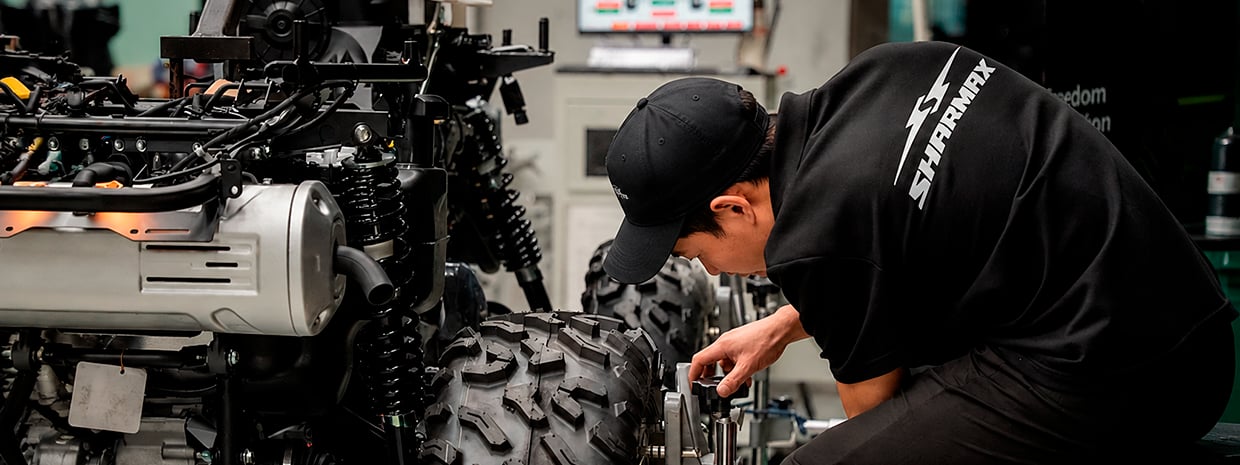
As invincible and rugged as they may seem, quad bikes still need care and attention. They take on some of the harshest off-road conditions with lots of beating on the way. So, even the toughest ATVs for sale are vulnerable to the wear-and-tear influence of sand and dirt. Knowing when and how to maintain your ATV properly will help it run longer and with fewer breakdowns on the way. In this ATV maintenance guide, we will cover the recommended service intervals and the main parts that need your regular attention.
Basic ATV maintenance
We have put together a set of practical ATV maintenance tips covering the main systems of your quad, so you can spot problems early and keep small issues from turning into expensive repairs.
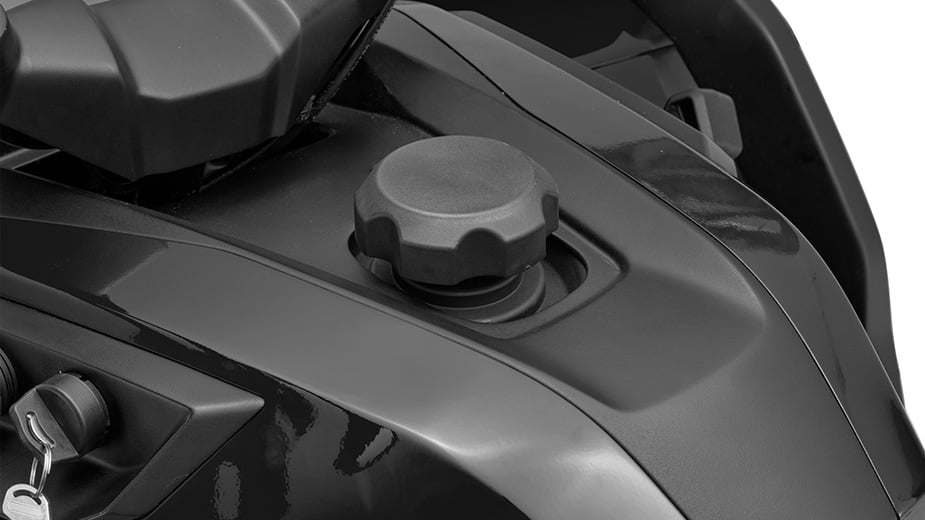
Engine oil and oil filter
The exact model’s manual sets oil-change limits by distance, engine hours and elapsed time, including break-in and severe-use schedules where specified. No generic interval replaces that schedule. Tracking the due date is different from performing an oil service, which requires the prescribed procedure and materials.
- at the mileage limit in the exact model’s manual
- at the engine-hour limit in the exact model’s manual
- at the elapsed-time limit in the exact model’s manual
Use whichever limit in your model’s schedule comes first, including shorter severe-use intervals where specified. Actual intervals can be substantially shorter than these examples.
Oil-filter service depends on engine design. Follow the model’s inspection or replacement interval and service procedure rather than assuming every ATV has the same replaceable filter. Ask the workshop to document the oil specification, filter and work performed.
Check the oil after every ride, especially after water crossings. A cloudy or milky appearance, foam, or visible emulsion may indicate water contamination. Catching it early can prevent rapid engine wear and costly repairs.
Long-term storage needs the model’s plan for oil, fuel and battery care, not one rule based on low mileage. Record the last service date and have a qualified technician prepare the vehicle if the procedure or required training is unavailable.
Suspension and drivetrain
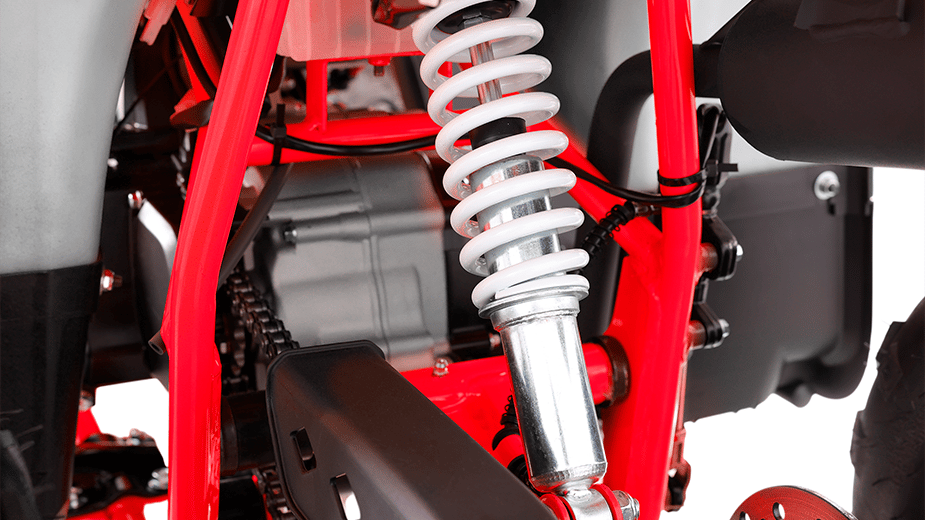
Suspension and drivetrain checks are an important part of ATV preventive maintenance, especially if the quad regularly sees rocks, water crossings, or deep sand.
Check for play, cracks, and leaks
Before setting off, check the steering rods, suspension arms, shock absorbers, and driveshafts for excessive play. Rock each wheel by hand and listen for knocks or clicking sounds.
Also inspect the following:
- CV-joint boots for cracks or tears
- shock absorbers for oil leaks
- suspension joints for loose fasteners
- driveshafts for unusual movement or damaged boots
A damaged CV boot may look like a small issue, but once sand gets inside, it mixes with the grease and acts like grinding paste. Replacing the boot early is much cheaper than replacing the joint.
CVT belt and variator
The CVT belt belongs on the service checklist: belt damage can leave the engine running while the ATV will not move. Inspect it and clean the housing using the model’s procedure and intervals, with extra attention after dust or water exposure. Six months or 500 km is not universal, nor is replacement after a few thousand kilometres. Investigate early if you notice:
- Slow acceleration from a standstill
- Slipping, especially at low rpm
- Engine revs rise when you open the throttle but the ATV does not move
- Smell of burning rubber or smoke coming from the variator housing
Inspect the belt with the engine stopped and cool, following the service procedure and using the specified tools. Do not remove pulleys or covers without knowing the correct method. Belt width must meet the service limit, with no cracking, peeling, fraying or grease contamination. Use a qualified technician if you are unfamiliar with the work.
Suspension arm grease
Serviceable suspension grease points need the specified lubricant and may require extra attention after water exposure or washing. Do not treat 300 km as a universal interval: follow the model’s lubrication points and schedule, and inspect the joints after wet or muddy use.
Grease-point locations and counts vary by design, and some sealed joints are not serviced in the same way. The manual specifies the points, grease type and quantity; do not assume every ATV has four fittings.
Engine, fuel system, and cooling
Sustained heat, fine sand and dust affect engine efficiency and component life. Maintenance in Egypt’s hot, dusty conditions therefore needs close attention to filtration, cooling and fuel, using the manufacturer’s severe-use schedule where specified.
Carburetor cleaning
Carburettor contamination can contribute to rough idling, hesitation or difficult starting, but those symptoms have other possible causes. Record what happens and ask a qualified workshop to diagnose the fuel system rather than spraying cleaner or dismantling parts as routine beginner maintenance.
Opening, cleaning and setting up a carburettor requires the exact service procedure, compatible materials and control of fuel and ignition hazards. Leave this work to a qualified technician. EFI models require a different diagnostic route; do not apply carburettor procedures to them.
Air filter
Air-filter care is especially important in Egypt’s dust and sand. A clogged filter restricts airflow and performance, while a damaged or poorly seated one can let abrasive particles reach the engine. Do not automatically wait a month after very dusty riding; inspect according to conditions and the model’s instructions.
Follow the model’s schedule and inspect after very dusty or sandy rides. Care depends on construction: a washable foam element may be cleaned, dried and oiled only as its instructions specify, while a non-washable paper element must not be washed and is replaced when required. Never reinstall a damp filter, and do not assume 500 km suits every condition.
While the filter is out, check the condition of the intake hoses, seals, and connections for cracks or loose fittings. Any gap in the intake path bypasses the filter entirely.
Cooling system
Check coolant with the engine cold and inspect the radiator after sandy or muddy rides. Sand, dry grass and mud can block fins and restrict airflow. Never remove the cap from a hot, pressurised cooling system.
Look externally for debris or damaged fins with the vehicle stopped and cool. Radiator cleaning must follow the manufacturer’s method: unsuitable compressed air or water jets can damage fins or relocate debris. Heavy blockage, leakage or repeated overheating calls for qualified service.
In extreme heat, slow riding can be harder on the cooling system than fast riding because less air passes through the radiator. If the temperature warning appears, stop and let the engine cool rather than trying to “ride through it.”
Spark plugs
Spark plugs ignite the fuel-air mixture. Follow the model’s inspection and replacement schedule; 6,000 km is not a universal interval. These symptoms call for ignition and fuel-system diagnosis rather than an automatic plug replacement:
- The engine takes multiple attempts to start
- Throttle response feels hesitant or uneven
- The ATV has lost noticeable acceleration
- Fuel consumption has increased on familiar routes
Plug count, type, gap and tightening torque depend on the engine design and manual; some engines use more than one plug per cylinder. Use the approved type and heat range rather than changing it simply because the weather is hot. Check the gap only as permitted for that plug; it affects spark formation, not ignition-timing adjustment. Overtightening can damage the cylinder-head thread.
Tires and brakes
Tire condition
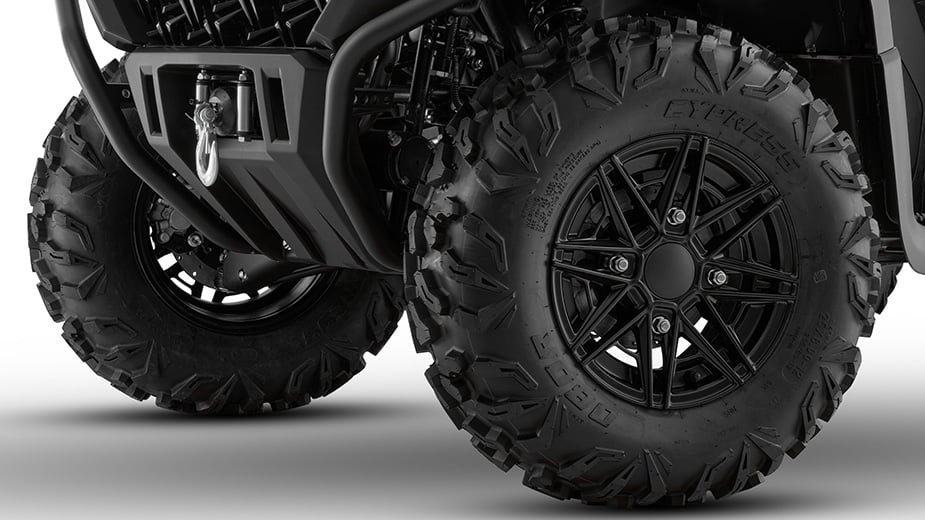
Good basic ATV maintenance also means paying attention to wheels. Worn tires affect braking, handling, and off-road traction, all of which matter more in loose or sandy terrain where grip is already reduced.
Check for:
- cuts or exposed cords
- cracked sidewalls
- missing tread blocks
- uneven wear
- damaged valve stems
- tread worn down to the indicator
Depending on the manufacturer, the wear indicator may appear as raised bars inside the tread grooves, printed numbers, or coloured markings.
Tire pressure
Check pressure before every ride. It takes two minutes and tells you immediately if there is a slow puncture developing. Keep a record of each tire's pressure — a single tire consistently lower than the others is the earliest warning of a leak.
Pressure affects grip, heat and wear. Set it cold to the vehicle and tyre specification for the load; do not reduce it for sand outside approved limits. The maximum sidewall figure is not necessarily the recommended operating pressure. Excessive underinflation can impair handling, generate heat or risk unseating the tyre.
Brake pads
Inspect pad thickness against the service limit instead of waiting for squealing or a longer stopping distance; those symptoms require a braking-system check. Wear varies greatly with sand, mud and riding style. Figures such as 300–600 km or over 1,000 km are examples, not fixed replacement intervals.
Replace pads in the sets and manner specified for your model’s braking system. Inspect discs and callipers as well, and do not assume front pads always wear first. Verify correct brake operation after service before returning to the trail, and use a qualified technician if you cannot perform the work safely.
Cleaning your ATV
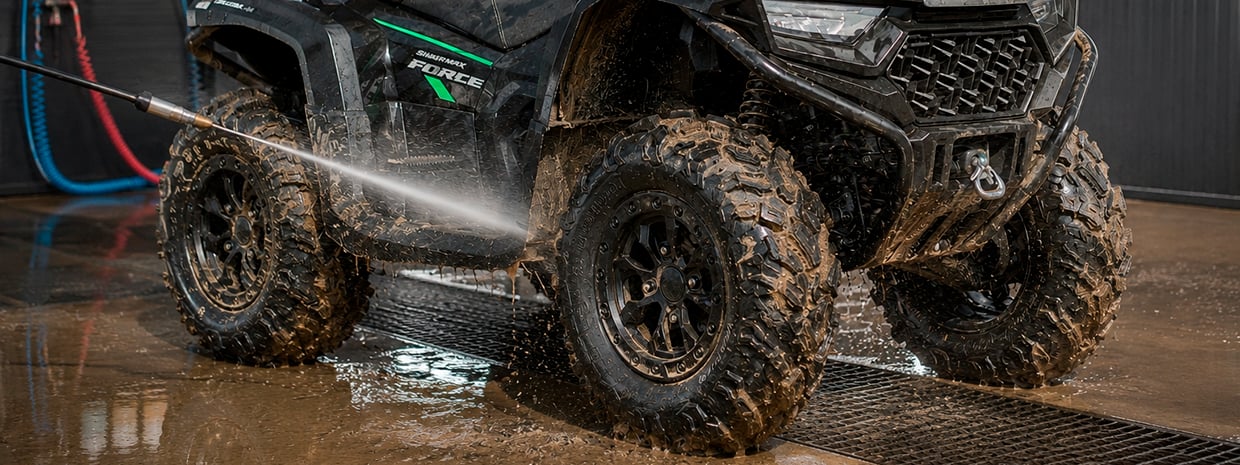
Cleaning is part of ATV preventive maintenance, but does an ATV really need a full wash after every sandy ride? Not always. A light layer of dry dust is less urgent than wet mud, salt, or sand packed around the radiator and suspension. However, the ATV should still be inspected after each outing and cleaned whenever debris begins to collect around moving or heat-sensitive parts.
After a typical sand ride, focus on:
- the radiator and cooling openings
- the airbox area
- suspension joints
- brake calipers
- the CVT intake and outlet
- the chain or exposed drivetrain parts
When using a pressure washer, keep the nozzle at a safe distance. Do not direct a concentrated jet at the radiator fins, switches, electrical connectors, control cables, decals, lamps, seals, or air intake.
After washing, dry the ATV with a soft towel and remove trapped water using the model-approved method, then lubricate the required points. If the manual calls for running the engine to dry components, do so outdoors only, never in an enclosed area. Monitor temperature and check the brakes before riding.
ATV maintenance schedule
The following table organises the questions needed to plan maintenance; it is not a replacement service schedule. Record the model-specific procedure and due date for each task, and distinguish a trained external inspection from work requiring a qualified workshop.
| Task | Record | Due date | Procedure and materials | Work boundary |
|---|---|---|---|---|
| Check engine oil level and condition | Visible condition and last inspection or service | Exact model and severe-use schedule | Fitted-system procedure, not a generic recipe | Trained external checks permitted by the manual; internal or critical-system service by a qualified technician |
| Change engine oil and filter | Visible condition and last inspection or service | Exact model and severe-use schedule | Fitted-system procedure, not a generic recipe | Trained external checks permitted by the manual; internal or critical-system service by a qualified technician |
| Inspect air filter | Visible condition and last inspection or service | Exact model and severe-use schedule | Fitted-system procedure, not a generic recipe | Trained external checks permitted by the manual; internal or critical-system service by a qualified technician |
| Check tires and pressure | Visible condition and last inspection or service | Exact model and severe-use schedule | Fitted-system procedure, not a generic recipe | Trained external checks permitted by the manual; internal or critical-system service by a qualified technician |
| Test brake operation | Visible condition and last inspection or service | Exact model and severe-use schedule | Fitted-system procedure, not a generic recipe | Trained external checks permitted by the manual; internal or critical-system service by a qualified technician |
| Inspect suspension, steering, and CV boots | Visible condition and last inspection or service | Exact model and severe-use schedule | Fitted-system procedure, not a generic recipe | Trained external checks permitted by the manual; internal or critical-system service by a qualified technician |
| Check CVT belt | Visible condition and last inspection or service | Exact model and severe-use schedule | Fitted-system procedure, not a generic recipe | Trained external checks permitted by the manual; internal or critical-system service by a qualified technician |
| Check coolant level and radiator | Visible condition and last inspection or service | Exact model and severe-use schedule | Fitted-system procedure, not a generic recipe | Trained external checks permitted by the manual; internal or critical-system service by a qualified technician |
| Inspect spark plug | Visible condition and last inspection or service | Exact model and severe-use schedule | Fitted-system procedure, not a generic recipe | Trained external checks permitted by the manual; internal or critical-system service by a qualified technician |
| Check electrical connectors | Visible condition and last inspection or service | Exact model and severe-use schedule | Fitted-system procedure, not a generic recipe | Trained external checks permitted by the manual; internal or critical-system service by a qualified technician |
| Coolant level and hoses | Visible condition and last inspection or service | Exact model and severe-use schedule | Fitted-system procedure, not a generic recipe | Trained external checks permitted by the manual; internal or critical-system service by a qualified technician |
This is a general ATV maintenance checklist. Always cross-reference with your owner's manual as manufacturer intervals take priority over general guidelines.
Closing thoughts: Be consistent with maintenance checks
The how to maintain an ATV question has a straightforward answer: consistently, and before something breaks rather than after.
Good ATV maintenance comes down to a few consistent habits.
- Check tire pressure before and after every ride. After wet or muddy outings, wash the quad and lubricate the suspension points specified by the manufacturer.
- Consumable parts also need periodic replacement. These include the engine oil and oil filter, CVT belt, air filter, tyres, spark plugs, and brake pads. Inspect the electrical connections roughly once a season, especially when the ATV regularly crosses water.
Following this simple ATV maintenance checklist helps you catch wear early and keep the machine ready for the next ride.
FAQ
How often should you change the oil in an ATV?
Follow the exact model’s mileage, engine-hour and elapsed-time limits, including its break-in service, and use the severe-use schedule where specified. No general distance or annual rule replaces those limits.
Do you need to wash an ATV after every ride?
Not after every light ride on dry ground. However, wash the ATV after riding through mud, wet sand, or salty conditions. After a dry desert ride, remove sand from the radiator, brakes, suspension joints, and air-intake area rather than reaching for the pressure washer automatically.
How often should you check the ATV air filter?
Follow the model’s schedule and inspect after very dusty or sandy rides rather than using 500 km as a universal threshold. A clogged filter restricts airflow; a damaged or poorly seated one can let sand into the engine.
What should be checked before every ATV ride?
A basic pre-ride ATV maintenance checklist should include tyre pressure, brakes, oil level, steering, suspension, and visible leaks. Also check for loose fasteners or damaged CV-joint boots. These quick checks can catch trouble before you are kilometres away from the nearest road.
Can beginner ATV maintenance be done at home?
Many basic ATV maintenance jobs can be handled at home, including checking fluids, tire pressure, filters, brake-pad wear, and visible damage. More complex work involving valve clearances, fuel injection, major electrical faults, or internal engine repairs is better left to a qualified technician.