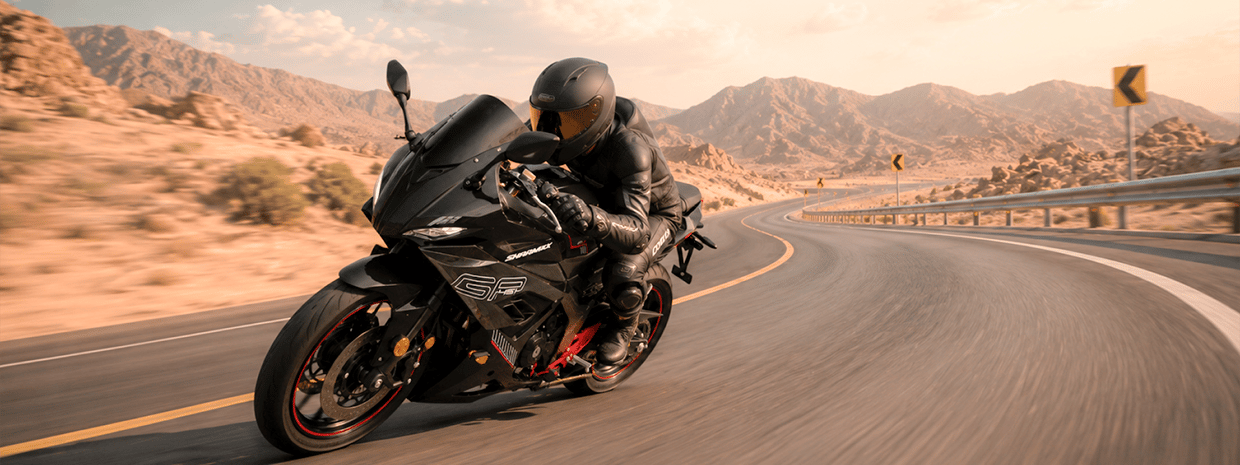
Fuel efficiency comparison of popular motorcycles in the UAE
Compare the fuel efficiency of popular motorcycles in the UAE. Discover which models offer better economy for daily riding and travel.
07 Aug 2026
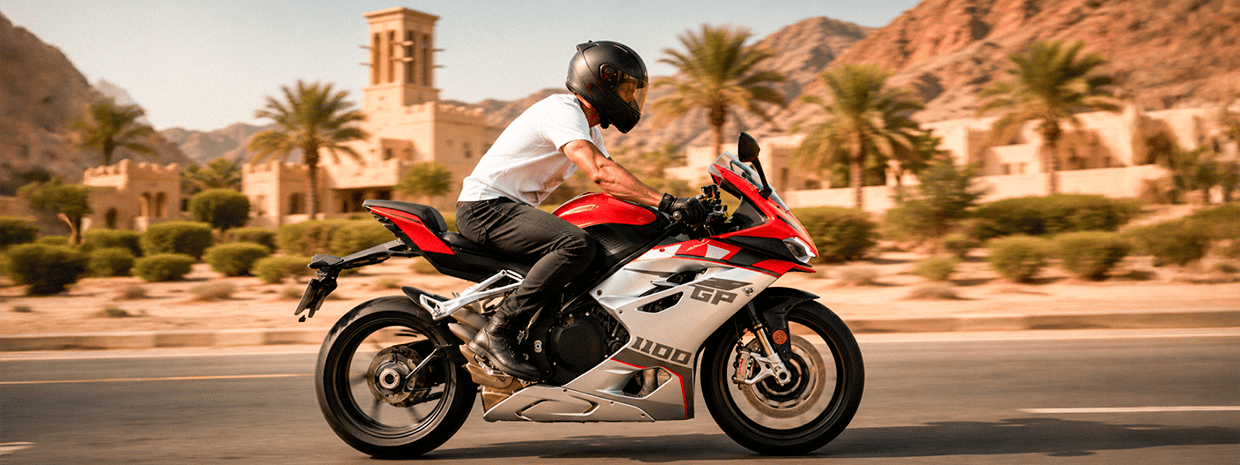
Motorcycles are valued for their agility and the sense of freedom. But apart from being fun, they have proven to be practical as well. Let's be honest: compared to a car, a smaller or mid-capacity bike is remarkably lighter on fuel. Over the same monthly distance, it may consume around half as much as an average petrol car. So, what makes motorcycles for sale economical in everyday use? Below, we examine the main factors behind fuel efficiency and highlight some of the best fuel-efficient motorcycles by Sharmax available in the UAE today.
What actually affects motorcycle fuel economy
Someone commuting daily through Dubai traffic and someone covering thousands of kilometres on Gulf highways are both watching the same number: litres consumed per 100 km. In both cases it feeds directly into what the bike actually costs to run. This motorcycle fuel efficiency guide breaks down what drives that number and which machines in the Gulf market handle it best.
Engine displacement and power
The relationship is straightforward: more displacement means more fuel burned, all else being equal. A 125 cc engine physically cannot consume what a 1000 cc engine does. But raw displacement is not the whole story. A tuned, high-compression 300 cc engine ridden aggressively will outspend a calm 500 cc unit from an older generation without breaking a sweat. That is why the most fuel efficient motorcycle is not always the smallest one. It is usually the bike with the right balance of power, weight, and purpose.
Motorcycle weight
Heavy machines demand more energy to accelerate. Cruisers in the 280–320 kg range consume noticeably more than lightweight city bikes ridden at the same pace. This is why models under 150 kg are very economical motorcycles. Bikes in this category deliver better consumption figures across the board — the engine is doing less work to move the same rider over the same distance.
Engine configuration
Single-cylinder engines are the most economical by design. Fewer moving parts, simpler valve timing, lower mechanical friction. Parallel twins and inline fours consume slightly more, though at highway cruising speeds the gap narrows considerably. V-twins — like the configuration in the RR 801 V Ultra — use a little more fuel than singles but deliver low-rpm torque that keeps gear changes minimal, which partially offsets the difference in real-world use. So, when choosing a fuel saving motorcycle, it is important to consider not only the fuel figure, but also how the engine behaves in real riding.
Aerodynamics and riding position
A full fairing reduces air resistance meaningfully. A sport riding position tucks the rider's body into the airflow rather than presenting it as a sail. Above 90 km/h, aerodynamics begin to influence fuel consumption more than engine displacement does. A naked bike and a fully-faired sport bike of identical displacement will return noticeably different figures at highway speeds — the fairing earns its keep in fuel savings over distance.
Riding style and conditions
Hard acceleration and late braking are the most direct route to poor consumption figures. Stop-start city traffic raises fuel use by 20–30% compared to steady highway cruising. Headwinds, elevation changes, and ambient temperature all contribute. The more controllable variable — riding style — accounts for a 15–25% swing in consumption between a smooth rider and an aggressive one on the same bike over the same route. Among all the factors that define fuel efficient motorcycles, this is the one entirely within the rider's control.
Average motorcycle fuel economy by engine size and class
By engine size
From 125 to 200cc
This is the most economical group, averaging around 2.0–2.8 litres per 100 km. The RST 150 Ultra and Street Bike 175 ME fit this range during calm everyday riding.
From 250 to 400cc
Average consumption rises to roughly 2.8–3.8 litres per 100 km. Models such as the RR 351, RST 351, GP 321 S, and Enduro 250 Travel still offer good motorcycle fuel economy for city trips and short rides outside town.
From 400 to 600cc
These bikes usually consume around 3.5–4.8 litres per 100 km. The GL 570 Ultra and RR 661 Ultra sit in the middle ground between stronger performance and manageable fuel use.
From 600 to 900cc
Fuel use normally falls between 4.5 and 6.5 litres per 100 km. Touring models may stay closer to the lower end, while performance bikes rise higher during active riding.
Above 900cc
Fuel consumption here usually sits around 6–8.0 litres per 100 km. The touring-focused GL 991 Ultra stays closer to 5 litres during steady highway riding, while the sportier GP 881 Ultra can move beyond the upper end when ridden hard. These powerful motorcycles are built primarily for speed and long-distance performance, so maximum fuel economy is not their main purpose.
By motorcycle class
Light street bikes
Small street bikes such as the RST 150 Ultra and Street Bike 175 ME Dubai are among the most fuel efficient motorcycles, commonly using around 2.0–3.0 litres per 100 km.
Naked bikes
Consumption varies widely with engine size. The RST 351 sits closer to the economical end, while larger models such as the RST 511 EU and RST 750 Ultra may use over 5-7 litres per 100 km.
Sport bikes
The GP 321 S sits near the lower end at around 3 litres per 100 km. More powerful models such as the GP 881 Ultra can move toward 6 litres or more during aggressive riding.
Touring and adventure motorcycles
These models generally consume around 4.0–6.5 litres per 100 km. The GL 991 Ultra may stay close to 5 litres during steady highway use.
Cruisers
The RR 351 can remain fairly economical, while heavier models such as the RR 661 Ultra and Custom 1000 RST Roadster may use around 8.0 litres per 100 km. Fuel saving is rarely their main priority.
Motorcycle fuel efficiency comparison
This motorcycle fuel efficiency comparison gives a quick overview of selected Sharmax models across several classes. The figures are approximate and can change with traffic, rider weight, road speed, weather, and throttle use.
| Bike Model | Engine and cylinders | Displacement | Approx. consumption | Notes |
|---|---|---|---|---|
| RST 150 Ultra | Single-cylinder | 150cc | Around 3.0 L/100 km | One of the motorcycles with best fuel economy for city use; light and easy to manage |
| Street Bike 175 ME | Single-cylinder | 196cc | Around 2.5–3.0 L/100 km | A strong candidate for the most fuel efficient motorcycle in the everyday Sharmax range |
| Enduro 250 Travel | Single-cylinder | 250cc | Around 3.5-4 L/100 km | An economical mixed-use option; consumption rises on loose terrain |
| GP 321 S | Single-cylinder | 240cc | Around 3.0–3.5 L/100 km | Sporty performance without the appetite of a large supersport |
| RR 351 | Twin-cylinder, EFI | 296cc | Around 3.2–4.0 L/100 km | A cruiser-style model with moderate consumption for its class |
| RST 351 | Single-cylinder | 300cc | Around 3.2–4.0 L/100 km | A practical middle ground between city efficiency and stronger road performance |
| GL 570 Ultra | Twin-cylinder, EFI | 554cc | Around 4.0–4.8 L/100 km | A balanced touring model for riders comparing comfortable yet economical motorcycles |
| RR 661 Ultra | Twin-cylinder, EFI | 465cc | Around 4.0–5.0 L/100 km | More torque and cruiser presence, with a predictable rise in consumption |
| RST 750 Ultra | Twin-cylinder, EFI | 698cc | Around 4.5–5.8 L/100 km | Stronger naked-bike performance; gentle throttle use makes a noticeable difference |
| GP 881 Ultra | Four-cylinder, EFI | 778cc | Around 5.0–6.5 L/100 km | Consumption rises quickly when the engine is kept high in the rev range |
| GL 991 Ultra | Twin-cylinder, EFI | 904cc | Around 5.0–6.0 L/100 km | Respectable highway efficiency for a powerful long-distance touring bike |
| GP 1100 Ultra | Four-cylinder, EFI | 987cc | Around 6.0–7.0 L/100 km | Built around acceleration and high-speed performance rather than minimum consumption |
Why claimed fuel consumption differs from real-world figures
Manufacturers measure fuel consumption under laboratory conditions at a fixed, controlled speed. Real riding includes acceleration, braking, and standing in traffic — and the number climbs immediately. Understanding this gap is the starting point for any honest motorcycle fuel efficiency comparison.
Different riding modes
The test cycle assumes steady-state conditions that exist in almost no real commute. The moment traffic slows, a hill appears, or the throttle opens past a gentle cruise, the official figure becomes a reference point rather than a prediction.
Fuel quality
Petrol with a lower octane rating than recommended, or with a high additive content, burns less efficiently. Using the correct grade is one of the simplest ways to keep real-world consumption closer to the manufacturer's figure — and one of the most commonly overlooked.
Load and luggage
Every additional 10 kg adds roughly 0.2–0.3 litres per 100 km to consumption. Loaded panniers, a heavy passenger, and a full backpack move the needle noticeably compared to a solo ride with nothing on the bike. The most fuel efficient motorcycle in a given category can still return poor figures if it is consistently overloaded.
Temperature and seasonal conditions
A cold engine runs rich — the first 5–10 km of a cold start can consume close to double the normal rate before the engine reaches operating temperature. This is why repeated short trips often return worse figures than one longer journey covering the same distance. Extreme heat can also affect efficiency. Cooling fans may run more often, while dense traffic gives the engine less airflow.
How to improve motorcycle fuel economy
Learning how to improve motorcycle fuel economy does not require drastic modifications. In most cases, small changes in maintenance and riding habits make the biggest difference.
Keep tire pressure within specification
An underinflated tire increases the contact patch and rolling resistance. Keeping pressure at the manufacturer's specified level costs nothing and saves fuel on every ride.
Follow the maintenance schedule
A clogged air filter, worn spark plugs, and thickened oil together can raise consumption by 10–15%. Staying on top of maintenance is direct fuel saving — not just mechanical upkeep.
Use smooth throttle inputs
Hard acceleration from a stop consumes fuel at a multiple of what a gradual, measured departure uses. Among all the approaches to running economical motorcycles cheaper, smooth throttle inputs require no investment and deliver immediate results.
Choose the right gear
Riding a gear too low keeps revs high and fuel consumption higher with it. On most motorcycles, shifting up at 3500–4500 rpm keeps the engine in its efficient range, reduces fuel use, and lowers wear simultaneously. Motorcycles with best fuel economy figures are often ridden by people who simply shift earlier than average.
Checklist: How to measure your actual fuel consumption
A useful motorcycle fuel efficiency guide should explain not only which bikes consume less, but also how to measure the result accurately.
Use the full-tank method
The full-tank method is simple:
- Fill the tank to the same level and record the odometer reading.
- Ride normally for at least 200–400 km.
- Refill to the same level and note how many litres were added.
- Divide the litres used by the distance travelled, then multiply by 100.
For example, if the motorcycle uses 12 litres over 300 km, the result is 4 L/100 km.
One measurement can be distorted by traffic or an inconsistent refill. Use at least three full-tank cycles before drawing conclusions.
Keeping a record
A simple table — date, odometer reading, litres added, calculated consumption — gives a clear picture after five to ten fill-ups. A sudden jump in consumption with no change in riding conditions is a reliable signal to check the air filter, spark plugs, and tire pressure before assuming anything more serious is wrong. Tracking consumption therefore helps identify the motorcycles with best fuel economy, but it can also act as an early maintenance warning.