Best sport motorcycle for beginners in Oman
Sport motorcycles stand in a league of their own. Aggressive, sharp, loud (sometimes way too much), they look like they escaped from a racetrack. Some will tell you they’re “too much” for a first bike, and in many cases they’re right. But Sharmax works from a different idea: even a supersport can be approachable if you choose wisely, stay realistic, and respect your own learning curve.
22 Jan 2026
This guide won’t tell you to chase the absolute best sport motorcycles on paper. It will show you what matters for beginners in Oman and how Sharmax GP models fit into that picture as more friendly, everyday choices.
Key features of sport motorcycles
Before we talk about beginners, let’s look at what defines this type of bike.
Design, aerodynamics, seating position
Sport machines are built to cut through the air and look fast even when parked. Fairings are narrow, front-heavy, and pointy. Clip-on handlebars sit lower, and the rider leans forward to reduce wind drag. This is the classic silhouette you see in lists of the best sport motorcycles, but in daily life that same posture can put extra weight on your wrists and neck. For a new rider, the real question is: can I live with this position for 30–40 minutes in Muscat traffic?
Frame and weight
Most sport bikes use stiff frames and firm suspension, which makes them precise in corners and stable at high speed but also sends every pothole and speed bump straight to your back. Frames are built from highly durable yet lightweight materials, so even a 1000 cc bike can easily be around 180 kg. Many models from the top sport motorcycle brands use aluminium or advanced steel frames to keep weight down.
Engine types, displacement and speed
Engines range from small single- or twin-cylinder units in the 250–400 cc zone to high-revving inline fours above 600 cc. Power delivery also changes: some are calm in the low rpm and wake up gently, others suddenly come alive in the upper half of the rev counter. Top speeds are easy licence-losers as such bikes can freely accelerate to 200 km/h in 3 seconds. What matters more for a beginner is how smooth the bike feels between 0 and 120 km/h, where everyday riding actually happens in Oman.
Fuel efficiency and range
Let’s be honest: nobody buys a sports machine to save every dirham at the pump. Even the best beginner sports motorcycles will not behave like a scooter at the fuel station. Still, smaller displacement models, especially in the 250–400 cc class, can be reasonably efficient and friendly to your fuel budget. Big engines, high rpm and long highway stints will always mean more fuel stops. That’s fine if you plan for it and don’t expect economy figures of a scooter.
Why sport motorbikes attract beginners
Ask a new rider what motorcycling looks like in their head, and chances are they’re picturing a full-fairing machine with an aggressive front and a screaming exhaust. Sport bikes hit all the classic dreams at once: race styling, sharp lines, bright colours, and the feeling that you’re riding the main character from a racing game. Sport machines look like the best looking sport motorcycles, so it’s no surprise many beginners start their search there.
The good news: this dream can work in real life if you pick the right tool. The bad news: jumping straight onto a full-blooded race bike is not a good idea. The trick is to keep the design and the feeling, but scale the performance to something your skills – and local traffic – can handle.
What makes a sport motorcycle suitable for beginners
If you’ve been googling what are the best sports motorcycles, you’ve probably seen lists full of 600–1000 cc rockets. Those bikes are fantastic machines, but they’re built for riders with experience, not for someone just getting their licence in Oman.
The best beginner sport motorcycle is not the one that wins the most track days. It’s the one that forgives clumsy shifts, shaky low-speed turns, and the occasional late brake at a roundabout in Muscat.
Manageable engine size and power delivery
For a first serious machine, engines in the 250–400 cc range usually hit the sweet spot. They have enough power to keep up on highways and enjoy twisty roads but not so much that a small mistake turns into a huge problem. Power that builds steadily, rather than exploding at high rpm, helps you learn throttle control without fear.
Predictable throttle response
Beginner-friendly sport bikes should feel like they’re talking to you, not shouting. When you twist the throttle a little, the bike should respond a little. No surprises, no big jumps. This makes parking-lot manoeuvres, U-turns, and slow riding in city centres far less stressful.
Weight balance and seat height
You do not need to flat-foot both sides, but you do need to feel roughly in control when stopped. For beginner-friendly sport bikes, dry weight in the 160–190 kg range is usually easier to live with than heavy 220+ kg machines. Seat height around 780–810 mm works well for many riders of average height. A bike that’s lighter and carries its weight low is much easier to push around in underground parking, at petrol stations and in tight spaces.
Electronic safety and braking systems
Modern sport machines often come with ABS as standard and sometimes with additional rider aids. For a new rider, ABS is more than a buzzword – it can save you from a locked front wheel on a dusty road or when someone cuts across unexpectedly. Traction control and riding modes can also help smooth the power, but they don’t replace technique or good judgement when you choose the most reliable sport motorcycle for your budget and skills.
Cooling systems for hot climates
Oman’s biggest test is not just speed, but heat. Long traffic lights, slow traffic on Sheikh Zayed Road and hot air reflecting from buildings can cook an engine quickly. Liquid-cooled bikes deal with this better than basic air-cooled designs. A machine that keeps its cool in August will feel safer, more consistent and much more enjoyable.
There is no single best sport motorcycle that suits every beginner, but there is a clear pattern: manageable power, forgiving geometry, sensible electronics and cooling that doesn’t surrender when the temperature goes above 40°C.
Choosing a sport motorcycle for everyday riding
Most rankings from the top sport motorcycle brands forget that people actually sit in traffic, ride in 45°C heat, and sometimes just want to go grab karak without doing 200 km/h.
Below are three models by Sharmax that prove the “sports” part should not get in conflict with usability.The GP family is built with real-world riding in mind rather than pure racing obsession. They are approachable both in handling and money-wise, with a price tage capped at AED 20,000.
Sharmax Super Sport GP 451 Ultra
The GP 451 Ultra is built for riders who want more “grown-up” performance but still plan to ride every day. Its 367 cc, two-cylinder, liquid-cooled engine produces around 27 hp, which is enough for proper highway work without turning every throttle twist into a drama. An 18-litre fuel tank gives generous range between stops, and a top speed close to 150 km/h covers anything legal you need to do between Muscat and Salalah.
With a more relaxed riding triangle than full race replicas and enough mass to feel planted without being a handful, it quietly competes for the title of the most comfortable sport motorcycle in the Sharmax lineup for daily conditions.
Sharmax Super Sport GP 401 Ultra
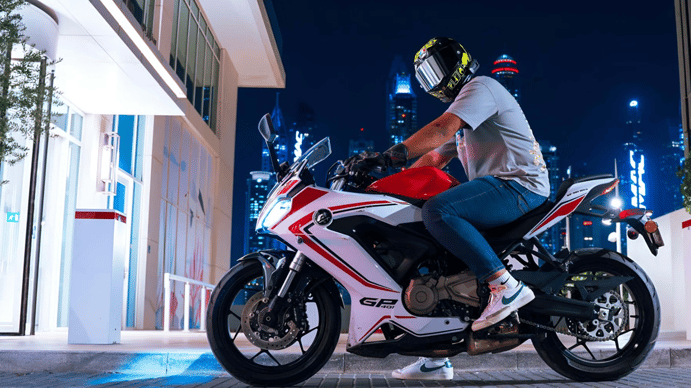
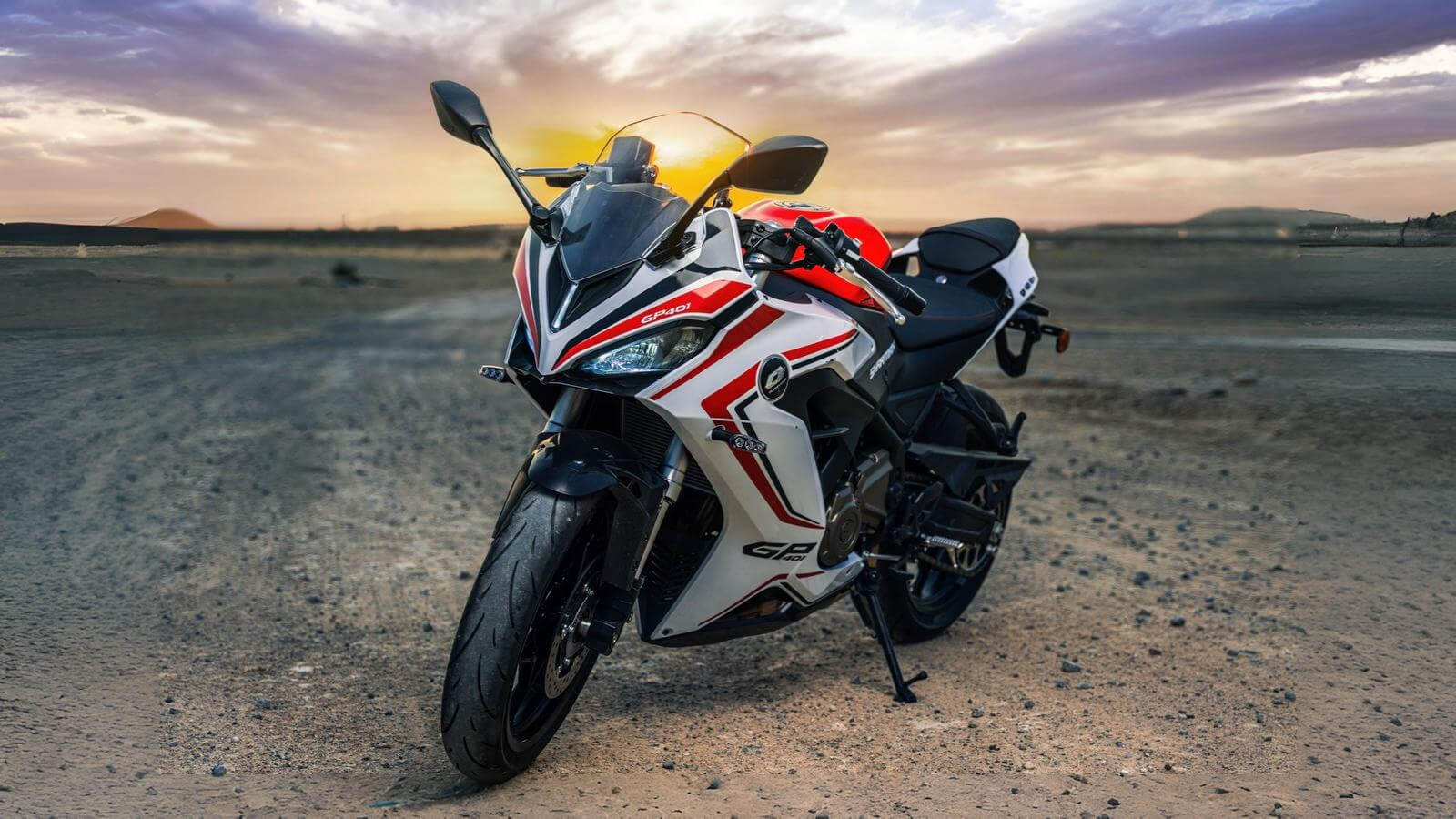
Moving up a step in displacement and character, the GP 401 Ultra combines a more powerful engine with upgraded chassis and components. Its 401 cc, 4-stroke, two-cylinder unit delivers about 44 hp, giving a clear jump in acceleration without becoming unmanageable. Dual-channel ABS, stronger brakes and a well-sorted suspension setup help keep that power in check on real roads.
Visually, the red-and-white, Italian-inspired bodywork makes it look like a mini-superbike you could park proudly anywhere on Sheikh Zayed Road. For many riders, this makes it feel like the best looking sport motorcycle in the family. In everyday use, the GP 401 Ultra is still more manageable than many big racing replicas, which makes it a serious but realistic option for someone who has outgrown smaller bikes and knows that a little patience now pays off later.
Safety tips for beginner sport motorcycle riders
Choosing the right machine is only half the story. How you ride it matters even more:
- Start with proper training, ideally including a course that covers emergency braking and cornering on a sport-style bike.
- Wear full protective gear, even for short trips – helmet, gloves, jacket, boots and at least basic armour.
- Build speed slowly; treat the first months as training, not as an audition for a racing contract.
- Learn to read traffic in Oman: lane changes without indicators, sudden exits, sand patches near construction zones.
- Respect your own limits and take breaks; fatigue and heat together turn even a gentle bike into a challenge.
Frequently asked questions
What engine size is best for beginner sport motorcycles?
For most new riders, engines in the 250–400 cc range offer the best balance: enough power to be fun and safe on highways, but not so much that every mistake becomes dramatic.
Are sport motorbikes practical for daily commuting?
They can be, if you choose a model with a relatively relaxed riding position and reasonable fuel consumption. Smaller and mid-sized sport machines handle daily commuting in Muscat quite well, especially if your route includes some faster roads.
Can beginners handle high-performance motorcycles?
With perfect self-control and training – maybe. In the real world, big race-focused machines are simply less forgiving. It’s more sensible to start lower, learn control, and move up when your skills and confidence catch up.
Is ABS necessary for a first sport motorcycle?
“Necessary” is a strong word, but ABS is an excellent idea, and most best beginner sport motorcycles have it. It gives you an extra safety net under hard braking, especially on dusty or sandy surfaces common in the region. For a first serious bike, it’s worth prioritising.
Bottom line: is a sport motorcycle right for you?
Sport machines are not the easiest path into riding, but they do speak directly to the imagination. If you understand their strengths and limits, choose the right engine size, and stay honest about your own experience, they can be a fun and rewarding way to start.
In the end, the most popular sport motorcycle is not the one with the highest top speed on paper; it’s the one its owner can ride confidently, day after day, without constant fear or regret. For some riders in Oman, Sharmax GP models fill that role very well, offering the visual drama and excitement of a sport bike in packages that make more sense for real roads, real traffic and real budgets.