Can you drive a golf cart on sand or beaches in the UAE?
Can golf carts drive on sand or beaches in the UAE? Learn where they can be used, what makes a golf cart suitable for sand and which models work best.
30 Oct 2026
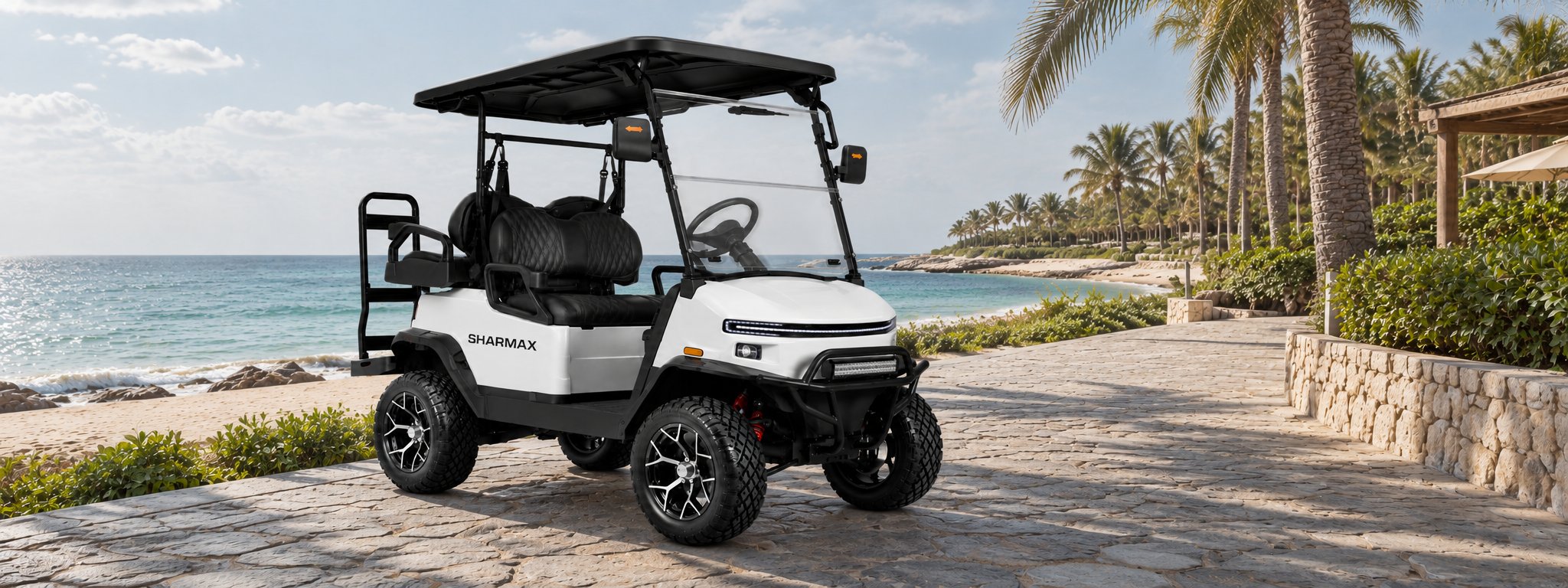
Do golf carts go on sand? Generally, yes — but not on every type of sand, and not everywhere you might want to drive one. A suitable golf cart can usually handle firm or relatively shallow sand but not deep and loose patches.
Public beaches are different. Private golf carts are not allowed there. Hotels, resorts, and residential properties may allow carts, but only on their own grounds.
So if you are looking for a golf cart for sale for a villa, resort or coastal property, it helps to know both where you can use it and what technical features matter on sand.
Below, we look at how golf carts behave on sandy terrain, what makes one better suited to it and when beach use may be possible.
Can golf carts drive on the beach in the UAE?
So, are golf carts allowed on beaches in the UAE? Don’t assume you can drive one onto just any public beach. Each public beach has its own access rules, and the municipality or the site operator decides which vehicles can move where.
Private property works differently. A beach resort or a hotel with its own stretch of coast can run golf cars on its grounds, and often lets them use set paths near the sand. The same goes for managed coastal communities.
Can you take a golf cart to the beach, then? Possibly, if the land is private and the operator says yes. On a public beach, check the local rules first, because “no one told me I couldn’t” won’t help you much if someone does object.
Can you drive a golf cart on sand?
Yes, but the type of sand makes a major difference.
A golf cart has a much better chance on:
- compacted sand;
- hard-packed sandy tracks;
- shallow, firm sand;
- maintained resort paths with a sandy surface.
It will have a much harder time on:
- deep dry sand;
- loose beach sand;
- heavily churned sand;
- steep sandy slopes.
The issue is rolling resistance. Tires sinks further into soft sand than it does on asphalt or a prepared path. The deeper it sinks, the more force the motor needs to keep the cart moving.
This is why a cart that crosses a firm sandy patch without difficulty may struggle only a few metres later when the surface becomes softer.
A golf cart should also not be treated as a replacement for an ATV or UTV. Even the best golf cart for sandy terrain is primarily a light transport vehicle, not a machine designed for dune riding.
Can electric golf carts drive on sand?
Yes. Being electric does not prevent a golf cart from operating on sand.
In fact, electric motors can provide useful torque immediately from low speed. What matters more is the complete vehicle setup.
When asking can electric golf carts drive on sand, look at:
- motor output and low-speed pulling ability;
- tire size and width;
- tread pattern;
- ground clearance;
- vehicle weight;
- passenger load.
Battery range also matters. Moving through sand creates more resistance than driving over smooth pavement, so energy consumption may increase.
That means a cart with a stated range of 60 or 70 km under normal conditions should not be expected to achieve exactly the same figure when spending significant time on difficult sandy surfaces.
What makes a golf cart suitable for sandy terrain?
If you are considering golf carts for beach driving this is what matters.
Wider tires
Wider tires spread the vehicle's weight over a larger contact area and help reduce how deeply the wheels sink.
For example, an 8–9 inch-wide tire is a much better starting point for firm sand than a narrow road-style tire.
Suitable tire tread
The tires need enough grip to keep the cart moving without excessive wheelspin.
A tread depth of roughly 5–7 mm is common on utility-style golf-cart tires. An all-purpose tread in this range can work well on compact sand, although tire width and load remain just as important.
Enough motor torque
Sand produces more resistance than a paved road, so the motor needs enough low-speed pulling power.
For a four-seat electric cart, around 4–5 kW or more is a useful reference point. For example, the Sharmax 5000 4 Seater Pro uses a 5 kW AC motor.
Ground clearance
Ground clearance becomes increasingly important as the sand gets deeper.
Around 150–180 mm is a useful range for a golf cart that may occasionally cross uneven or shallow sandy sections. The Sharmax 5000 4 Seater Pro has 175 mm of ground clearance.
Vehicle weight and passenger load
A heavily loaded cart will generally sink further into soft sand.
For example, a four-seat cart carrying two adults may add around 140–180 kg of passenger weight, while four adults can add roughly 280–360 kg. That extra load can make a noticeable difference on softer sand.
When considering how to choose a model for sand, look for a combination of roughly 8–9 inch-wide tires, 150–180 mm of clearance and around 4–5 kW or more of motor power, while keeping the passenger load reasonable.
Can golf carts get stuck in sand?
Yes. Can golf carts get stuck in sand is an easy question to answer: even a relatively capable cart can become stuck if the surface is loose enough.
Common reasons include:
- tires sinking too deeply;
- carrying too much weight;
- stopping in a particularly soft patch;
- accelerating aggressively and spinning the wheels;
- making sharp turns in loose sand;
- trying to climb a soft sandy incline.
Wheelspin is particularly problematic. Once a tire begins spinning without moving the cart forward, it can dig itself deeper into the surface.
A cart may also cross the same section successfully while maintaining momentum but struggle to move again if the driver stops halfway through.
How to drive a golf cart on sand
If the property allows it and the cart is suitable, a few simple techniques can make driving a golf cart on sand easier.
Useful golf cart sand driving safety tips include:
- choose the firmest route available;
- maintain a steady, moderate speed;
- avoid sudden acceleration;
- make gradual steering inputs;
- avoid unnecessary stops in loose sections;
- reduce passenger or cargo load when possible;
- avoid deep sand if there is a firmer route around it;
- stop accelerating if the wheels begin digging into the surface.
The aim is to maintain smooth forward movement without asking the tires to find more grip than the surface can provide.
Which Sharmax golf carts are better suited to sandy terrain?
The current Sharmax UAE range includes compact four-seat carts as well as larger passenger models.
| Model | Ground clearance | Max load | Motor | Sand-use assessment |
|---|---|---|---|---|
| 5000 2+2 Seater | 175 mm | 600 kg | 5 kW | Good option for short stretches of firm sand, especially with a lighter passenger load |
| 5000 4 Seater Pro | 180 mm | 600 kg | 5 kW | Slightly more clearance and a balanced setup for mixed paved and sandy routes |
| 5000 6 Seater Pro | 180 mm | 800 kg | 5 kW | Suitable for firm sand, but a heavier passenger load can make softer sections more difficult |
Pick by how many people you’ll carry. A lighter cart is easier to keep moving on soft ground, so the 2+2 or the 4 Seater Pro is usually the better start for sandy paths. The 6 Seater Pro is bigger and heavier, so it makes more sense on firm, flat routes.
All three models use 23×10-14 tires front and rear, giving them a relatively wide 10-inch tire profile. This is useful on firm or shallow sand because the wider contact area helps reduce how quickly the wheels sink.
Overall, all three have a similar technical base for occasional sand use: a 5 kW motor, around 175–180 mm of ground clearance, and the same tire setup. The main difference is how much weight they may carry. The larger the load, the more difficult soft sand becomes.
So the 2+2 Seater and 4 Seater Pro are the more natural choices for regular light-duty use around villas, resorts or private coastal properties, while the 6 Seater Pro is better suited to group transport where the route remains mostly firm.
So, can you drive a golf cart on sand or the beach in the UAE?
A golf cart can work well on firm sand, particularly around resorts, villas and other private properties. Once the surface becomes deep and loose, though, it is better to choose another type of vehicle.
Public beaches are a different matter. Access is controlled, so a private golf cart should only be used where the beach or property operator allows it.
For buyers who expect to cross occasional sandy sections, models such as the Sharmax 5000 2+2 Seater and 5000 4 Seater Pro offer the kind of setup discussed above. The key is to match the cart to the route rather than expect it to perform like an off-road vehicle.
Check out more golf cart models online or visit the Sharmax showrooms in the UAE.